

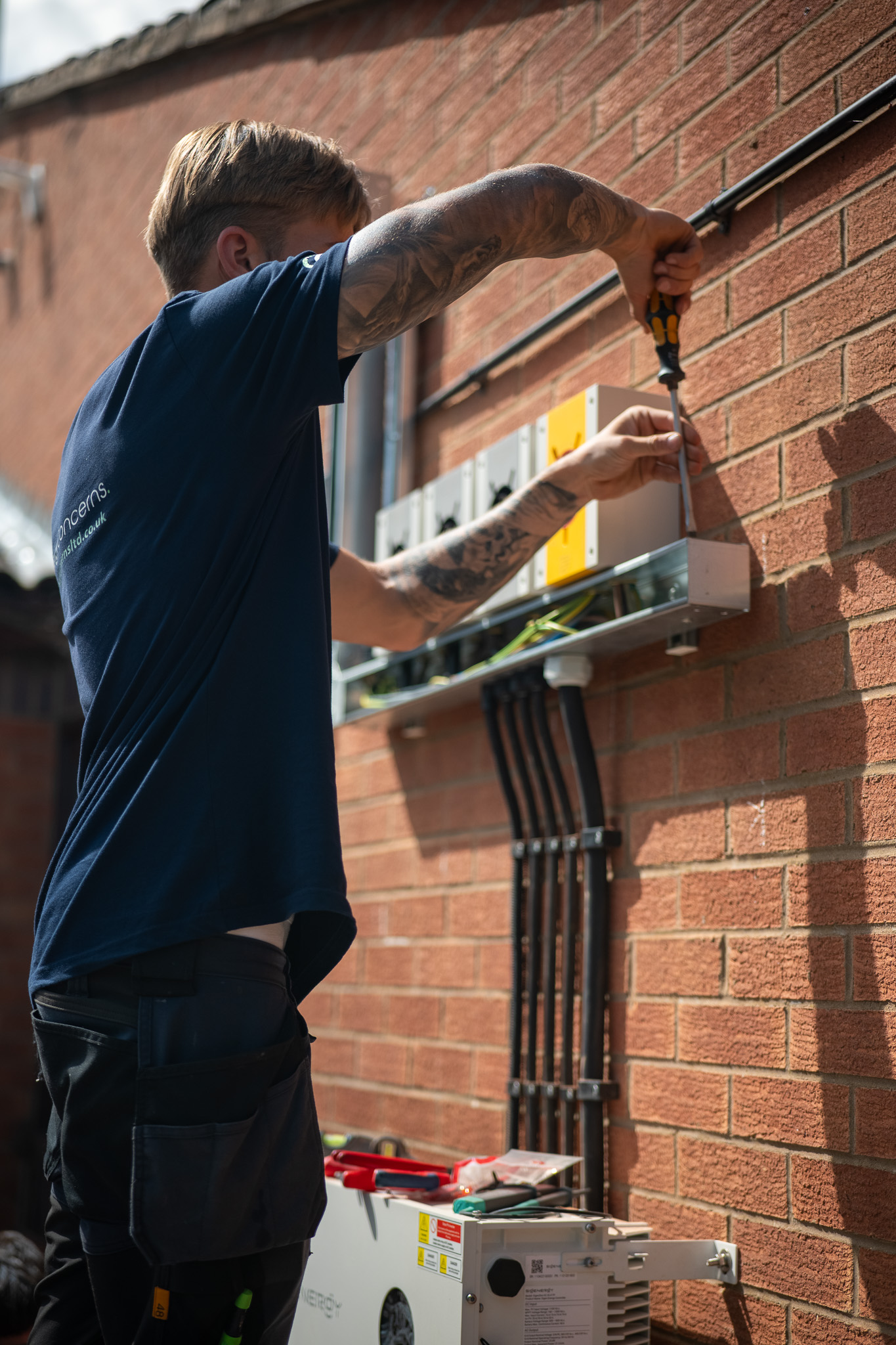
The short answer: most home EV charger installations in Leicester cost £950–£1,400 fully installed for a 7kW smart charger, with the Zappi V2 from £950. Where your install lands in that band depends on three things: the cable run from your consumer unit to the parking spot, the state of the consumer unit itself, and the charger you choose. This guide takes each in turn, sets out who still gets the £500 grant in 2026, and shows what charging at home then costs per top-up.
What the quote itemises
A fixed EV charger quote should name every part of the job, so you can see where the money goes. These are the lines that make up the £950–£1,400 band, and what pushes each one up or down.
| Item | What moves it |
|---|---|
| The charger | The model you choose: tethered or untethered, solar diversion, tariff scheduling |
| Cable run | Distance from the consumer unit to the parking spot, and whether it goes through walls, lofts or along the outside |
| Consumer unit | Whether it has a spare way and suitable protection, or needs work first |
| Earthing | How the charger is earthed at your property, checked at survey |
| Groundwork | Only where the cable has to cross a garden or drive to a detached garage |
| Commissioning | Testing, certification and setting up the app on your tariff |
The bottom of the band is a short, straightforward run from a consumer unit with room to spare. Long runs and consumer-unit work move it up, and both are priced as separate lines before any work starts.
The cable run: the biggest variable
The single largest difference between two quotes is how far the cable has to travel. A charger on the outside wall right behind the consumer unit needs a short run and little making good; a charger at the far end of a driveway, or on a detached garage, needs a longer run and sometimes groundwork. Photos of the consumer unit and the parking spot are usually enough to estimate the run before the survey confirms it.
Your consumer unit
The charger needs its own protected circuit from the consumer unit. Many Leicester homes have a unit with a spare way and suitable protection, and the install goes straight ahead. Older units sometimes need work first, which is why it is quoted as its own line rather than hidden in the headline price. We check it at survey and tell you before anything is booked.
Tethered or untethered
A tethered charger has the cable fixed to the unit, so you plug straight into the car. An untethered charger has a socket and you use your own cable, which suits households with more than one car or a car that may change. Neither is better in general; it comes down to how you park and how many cars use the drive.
Solar owners: choose the charger differently
If you have panels, or plan them, the charger choice changes. A solar-diversion charger such as the Zappi V2 watches your generation and sends surplus into the car before it is exported, so on a sunny afternoon the car charges from your own roof. Tariff-smart chargers such as the Hypervolt Home 3 suit time-of-use tariffs, filling the car in the cheap overnight window. Our Zappi installer page covers the diversion modes, and if you are adding panels at the same time, solar panels with battery explains how the three work as one system.
What charging at home then costs
Running cost depends on your tariff. At the Ofgem price cap for 1 October to 31 December 2026, the GB average electricity rate is 26.32p per kWh, so putting 40 kWh into the car costs about £10.53. On a time-of-use tariff such as Octopus Flux in the East Midlands, the overnight import rate was 13.84p per kWh when we read it on 18 October 2026, so the same 40 kWh in the cheap window costs about £5.54. Rates change, so check your own tariff before you compare.
Flux is built for homes with solar and a battery; our Octopus Flux guide explains how the windows work and when a different tariff suits a car-only household better.
Who still gets a grant in 2026
Since 1 April 2026 the OZEV chargepoint grants are worth up to £500: for flat owners and renters with private off-street parking, for households with on-street parking that need a cross-pavement solution, and for residential landlords (up to £500 per socket). Homeowners living in a house with a driveway are not eligible. All five schemes are confirmed until 31 March 2027. Full eligibility is in our EV charger grants guide.
Landlords, flats and businesses
Residential landlords can claim up to £500 per socket. Businesses, charities and public bodies use the Workplace Charging Scheme instead: up to £500 per socket for installs completed on or after 1 April 2026, up to 40 sockets per applicant. Business installs are scoped differently, from the site's supply and the number of bays, and are covered on our commercial EV charging page.
Leicester and the wider county
The cost factors are the same across the county; what changes is the property. Our EV charger installation in Leicester page sets out the chargers we fit and how an install runs, and the town pages cover local detail: EV chargers in Leicester, Hinckley and Loughborough.
Getting a fixed number
Photos of your consumer unit and parking spot are usually enough to start. The quote then lists the charger, the cable run, any consumer-unit work and any groundwork as separate lines, with the grant shown where you qualify. Start on the EV chargers page, or request a quotation directly.
Frequently Asked Questions
Ready to get it installed?
Get your free, no-pressure quotation
Tell us what you’re interested in — solar, battery storage, EV charging or air conditioning — and we’ll come back with an itemised quote. No salesman, no obligation.
From £950 fully installed — the solar-diversion charger we fit most for homes with panels. Longer cable runs or consumer-unit upgrades are itemised separately in the fixed quote.
Only if you own and live in a flat, or rent your home, with off-street parking, or you need a cross-pavement solution for on-street parking. Homeowners in a house with a driveway are not eligible. Landlords and businesses have their own £500-per-socket routes since April 2026.
At the Ofgem price cap for 1 October to 31 December 2026 (26.32p per kWh, GB average), 40 kWh costs about £10.53. On Octopus Flux's East Midlands overnight rate (13.84p per kWh, read 18 October 2026) the same 40 kWh costs about £5.54. Check your own tariff, as rates change.
Not always. The charger needs its own protected circuit; many consumer units can take it, older ones sometimes need work first. It is checked at survey and quoted as a separate line, so you know before anything is booked.
Free, no obligation
Ready to go solar in the East Midlands?
Energy Concerns is MCS certified, RECC registered, and 5-star rated. We cover all of the East Midlands and Warwickshire — book a free survey and we'll give you honest, personalised advice.