

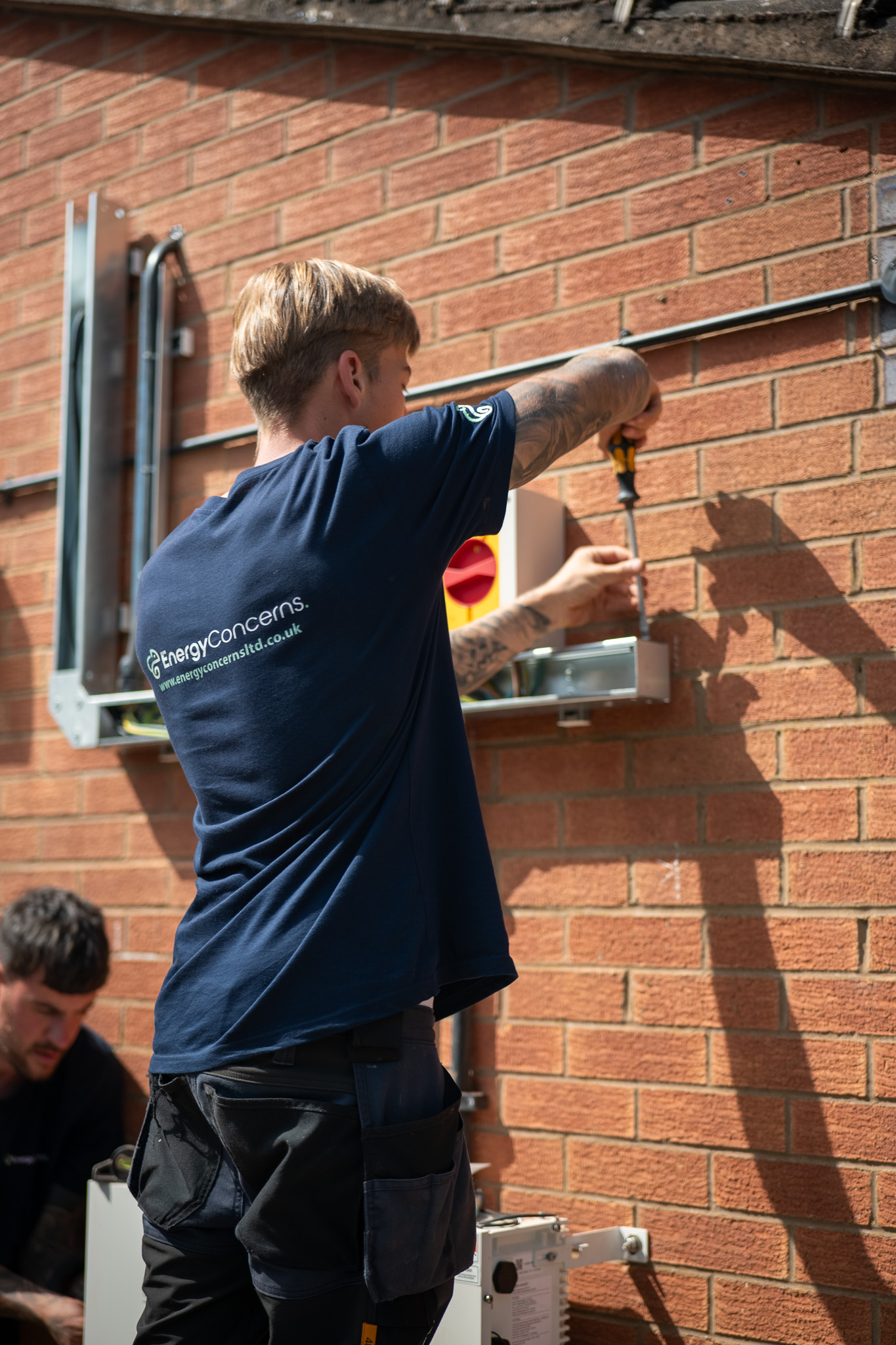
Charging an electric car at home in Leicestershire is far cheaper and more convenient than relying on public chargers — but only if the installation is done properly. This guide, from the MCS-certified team at Energy Concerns Ltd here in LE9, walks you through everything a Leicestershire homeowner needs to know in 2026: which home chargers actually earn their keep (we fit a lot of Zappi and Hypervolt units), whether you qualify for the EV chargepoint grant, how to charge from your own solar panels for close to nothing, and what a real installation costs. No jargon, no inflated promises — just accurate, local advice from an installer that lives and works in the East Midlands.
Why install a home EV charger in Leicestershire?
A dedicated 7kW home charger transforms EV ownership. Instead of a slow three-pin plug (which takes the best part of a day and isn't designed for continuous high loads), a wall-mounted charger typically adds a full charge overnight. For most Leicestershire households that means plugging in when you get home and waking up to a full battery — no detours to a public rapid charger.The bigger win is cost. On a dedicated EV tariff such as Intelligent Octopus Go or a similar off-peak plan, overnight electricity can cost a fraction of daytime rates, so home charging is dramatically cheaper per mile than public charging or petrol. Across a spread-out county like Leicestershire — from Hinckley and Market Harborough to Loughborough, Melton Mowbray and the villages around Leicester — most drivers cover enough miles for a home charger to pay back the difference against public charging quickly.
There's also a practical resale angle: a properly installed, notified home chargepoint is increasingly expected by EV buyers, and a compliant install (correctly notified to your DNO where required) protects your electrical system and your warranty.
Zappi vs Hypervolt vs the alternatives: which charger?
We fit a range of chargers, but two names come up most often with Leicestershire customers:- myenergi Zappi — a British-made 7kW smart charger with a genuinely useful trick: an eco+ mode that charges your car using only surplus solar power. If you already have (or plan to add) solar panels, the Zappi is often the standout choice because it diverts spare generation straight into the battery instead of exporting it.
- Hypervolt — a sleek, well-built 7kW smart charger with strong app control, load balancing and solar-matching features. Popular where design and a polished app experience matter.
The EV chargepoint grant: are you eligible?
The old headline grant for standard homeowners with off-street parking closed some years ago, so most houses no longer qualify for a domestic grant. However, the government's EV chargepoint grant still runs for specific groups — and the eligibility rules matter, so check yours rather than assume.The current grant is aimed primarily at:
- People living in flats and rental properties — the EV chargepoint grant for flat owner-occupiers and renters can cover a share of the cost of a socket and installation.
- Landlords — a separate landlord-focused grant supports installing chargepoints across residential and commercial rental properties.
Solar-smart charging: fuel your car from your own roof
This is where Leicestershire homeowners with solar panels get the biggest advantage. A solar-aware charger like the Zappi (eco+ mode) or Hypervolt monitors what your panels are generating in real time and sends any surplus — power you'd otherwise export — straight into your car.The East Midlands gets a solid amount of usable sun: a well-sited system here generates roughly 950–1,050 kWh per year for every kWp installed. So a typical 4kW array produces around 3,800–4,200 kWh a year. On sunny days, that spare midday generation can top up your EV for effectively nothing.
There's a smart trade-off to understand. Under the Smart Export Guarantee (SEG), exported electricity earns you roughly 5–15p per kWh depending on your supplier (Octopus, British Gas and others each set their own rate). But charging your car with that same power avoids buying grid electricity at a much higher rate — so using your solar in the car is almost always worth more than exporting it. A solar-matching charger makes that happen automatically. Pairing solar with a home battery lets you store cheap or free energy and charge the car later, including overnight.
What does EV charger installation cost in Leicestershire? (2026)
For a standard installation, expect a supplied-and-fitted 7kW smart charger to fall broadly in the region of £800–£1,300, depending on the unit you choose and the complexity of the job. A premium charger, or a run that needs a long cable, trenching, or consumer-unit work, pushes toward the upper end; a straightforward install close to the fuse board sits lower.What drives the price:
- Distance from your consumer unit to the parking spot — longer cable runs and any trenching add labour and materials.
- Consumer unit condition — older boards may need an upgrade or a dedicated protected circuit.
- The charger itself — Zappi, Hypervolt and equivalents vary in price and features.
- DNO notification — some installs require notifying your network operator; we handle this.
Combining solar, battery and EV charging — the Leicestershire sweet spot
The households that save the most treat solar, battery storage and EV charging as one system rather than three separate purchases.Here's the logic. A 4kW solar system in Leicestershire typically costs around £6,000–£8,000 and saves roughly £700–£1,100 a year, giving a payback of about 6–9 years — and that's before you factor in cheap car charging. Add an EV charger that soaks up surplus generation, and you extract more value from every kWh your roof produces instead of exporting it for a modest SEG rate.
There's a genuine cost incentive to act while it lasts: domestic solar and battery installations currently carry 0% VAT until 31 March 2027, after which the rate is expected to rise to 5%. That's a real saving on the whole solar-and-battery package if you install before the deadline.
For lower-income households or those in a lower-EPC-band home (EPC D–G), it's worth checking eligibility for ECO4 and the Warm Homes: Local Grant, which can fund solar for qualifying properties. Note these support energy-efficiency and solar measures rather than the EV charger itself — but a funded solar system still makes home car charging far cheaper.
Why use a local MCS-certified installer?
An EV charger is a fixed piece of electrical infrastructure carrying significant, sustained current — it must be installed by a competent, qualified electrician, notified correctly, and certified. Choosing a local Leicestershire installer means someone who can survey your property properly, stand behind the work, and come back if anything needs attention.Energy Concerns Ltd is a family-run installer based in LE9, covering Leicester, Leicestershire and the wider East Midlands. We're MCS-certified and members of RECC, NAPIT and TrustMark — the accreditations that matter for solar, battery and electrical work, and that give you real consumer protection. Because we fit solar PV, battery storage, EV chargers and air conditioning, we can design a joined-up system rather than bolting an EV charger onto an install that wasn't planned for it.
If you're weighing up a home charger — with or without solar — get a free, no-obligation quote through our website. We'll survey your property, explain your grant and tariff options honestly, and give you a fixed price with no pressure.
Frequently Asked Questions
Ready to get it installed?
Get your free, no-pressure quotation
Tell us what you’re interested in — solar, battery storage, EV charging or air conditioning — and we’ll come back with an itemised quote. No salesman, no obligation.
A standard 7kW home charger installation is usually completed in a few hours — often a single morning or afternoon. Jobs that need a long cable run, trenching, or consumer-unit work take longer. After a free survey we give you a fixed quote and a realistic timeframe before booking.
Yes. A solar-aware charger such as a myenergi Zappi (eco+ mode) or a Hypervolt monitors your panels and diverts surplus generation straight into your car. In Leicestershire a system generates roughly 950–1,050 kWh per kWp each year, so on sunny days you can top up your EV for effectively nothing instead of exporting that power for a lower SEG rate.
The grant now targets specific groups rather than all homeowners: people in flats and rented homes, and landlords, may qualify. To claim, the charger must be an OZEV-approved model fitted by an OZEV-authorised installer, and you must meet the scheme conditions. Standard houses with a driveway generally no longer qualify. We confirm the current rules and your eligibility before you commit.
A supplied-and-fitted 7kW smart charger typically falls in the region of £800–£1,300, depending on the unit and how complex the install is. Cable length, consumer-unit condition and DNO notification all affect the figure. We provide a fixed quote after a free survey so there are no surprises.
Usually yes — doing both in one visit is more cost-effective than two separate jobs, and it lets us design a joined-up system so your charger uses surplus solar automatically. Domestic solar and battery also carry 0% VAT until 31 March 2027 (rising to 5% after), so there's a genuine saving in installing the solar side before that deadline.
We're based in LE9 and cover Leicester, Leicestershire and the wider East Midlands — including Hinckley, Loughborough, Market Harborough, Melton Mowbray and surrounding villages. As a family-run, MCS-certified installer (RECC, NAPIT, TrustMark), we handle solar, battery, EV charging and air conditioning. Get a free, no-obligation quote through our website.
Free, no obligation
Ready to go solar in the East Midlands?
Energy Concerns is MCS certified, RECC registered, and 5-star rated. We cover all of the East Midlands and Warwickshire — book a free survey and we'll give you honest, personalised advice.