

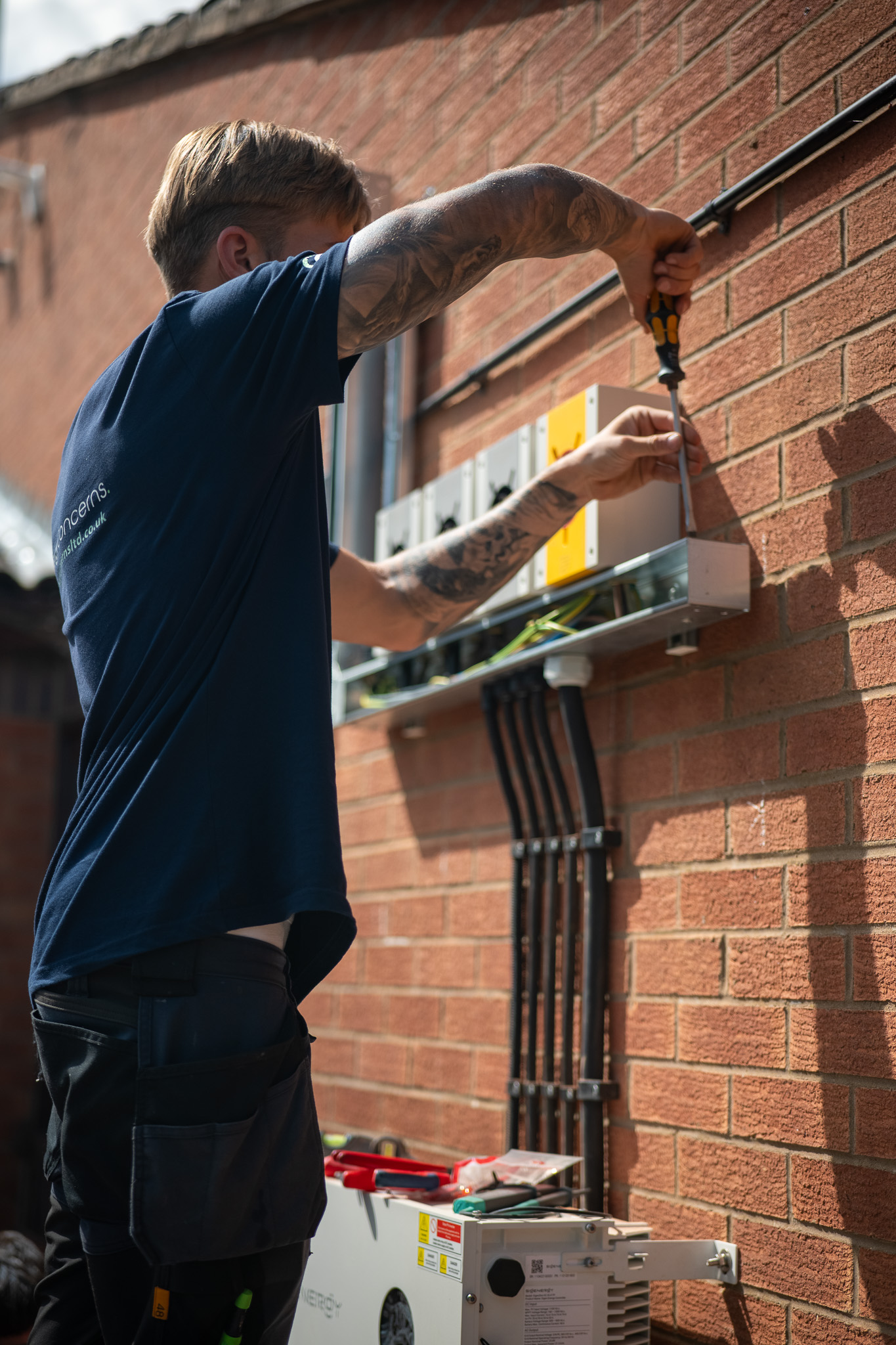
The short version
Our solar installations typically cost £4,000–£10,000 installed; the battery is sized to your evening usage and priced on the quotation. Both are zero-rated for VAT until 31 March 2027. In Leicester a 4 kWp array generates about 3,920 kWh a year (PVGIS), and a battery on a time-of-use tariff turns the part of that you would otherwise export for around 12p into electricity you do not buy at the evening peak.
Energy Concerns is an MCS-certified installer based in Leicester, fitting SigEnergy and Fox ESS batteries with solar across Leicestershire and about 30 miles around the city.
Why panels and a battery are better designed together
Solar on its own generates most between late morning and mid-afternoon, which is when most homes use least. Without a battery, that surplus goes to the grid for an export payment of around 12p/kWh (Octopus Outgoing, read 18 October 2026), and the household buys it back in the evening at a unit rate the Ofgem price cap puts at 26.32p/kWh for October to December 2026 (GB average, no VAT on household electricity until 31 March 2027). A battery closes that gap: it holds the afternoon’s generation for the evening.
Designing the two together matters for three practical reasons. The inverter is chosen once, as a hybrid that runs both, rather than bought for solar and replaced for the battery. The export limit is set once, with the battery’s discharge inside the 16 A per phase G98 route rather than forcing a G99 application later. And there is one survey, one scaffold, one quotation and one commissioning visit instead of two of each.
If you already have panels, none of this is lost: a battery retrofitted to existing solar is still zero-rated for VAT until 31 March 2027, and our battery storage page explains how a retrofit is sized and fitted.
What a Leicester roof generates, by system size
Figures from PVGIS (the European Commission’s solar database, SARAH3 data) for a south-facing roof in Leicester at a 35° pitch with 14% system losses: about 981 kWh per kWp a year. East-facing or west-facing roofs and shallower pitches generate less; we model your actual roof at the survey.
| System | Annual generation (PVGIS, Leicester) | Typical fit |
|---|---|---|
| 3 kWp (about 7 panels) | around 2,940 kWh | A two-person home or a small terrace roof |
| 4 kWp (about 9-10 panels) | around 3,920 kWh | The most common family-home system |
| 5 kWp (about 12 panels) | around 4,900 kWh | Larger semis and detached homes |
| 6 kWp (about 14 panels) | around 5,880 kWh | EV at home, or a heat pump planned |
Generation estimates only; they do not include the battery’s round-trip losses or your home’s actual usage pattern. Nearby cities are within a few per cent: Northampton about 1,017 kWh/kWp, Nottingham 970, Birmingham 968, Derby 974 (PVGIS, same settings).
Sizing the battery: evening usage, not array size
The battery has to hold what the house uses between sunset and bedtime, not what the roof makes at noon. A household that cooks, washes and charges a car after 6pm needs more storage than one that is out until nine, even with the same panels. We size from your bills and your routine, and the method is set out step by step in our battery sizing guide.
Both systems we install are modular. SigEnergy’s SigenStor stacks battery modules of around 5 kWh and 8 kWh usable under a single hybrid unit with an integrated EV charger; our SigEnergy installer page covers it. Fox ESS’s ECS range stacks smaller high-voltage modules, up to seven in a stack; see the Fox ESS battery installer page. Either way you can start with the storage you need now and add modules later without rewiring.
The tariff is the third part of the system
A battery on a flat-rate tariff only stores your own solar. On a time-of-use tariff it also fills from the grid when electricity is cheapest and empties at the peak. On Octopus Flux in the East Midlands (read 18 October 2026) the overnight import window was around 13.8p/kWh, the 4–7pm import price around 32.3p, and the peak export payment around 27.7p/kWh, so a full battery at 4pm is worth selling as well as using. Rates are regional and change; check your postcode on the supplier’s site.
Flux needs solar, a compatible battery and a smart meter, which is exactly what this package delivers, and both SigEnergy and Fox ESS automate the charge and export windows from their apps. The full comparison with Go and Agile is in our Octopus Flux, Go and Agile guide. If a car is coming, EV charger installation in Leicester is specified into the same system so the charger draws on the battery overnight.
What the quotation includes
Survey and design
Roof measurement and shading, your usage pattern, and a PVGIS-based generation model for your actual roof.
Panels, hybrid inverter and battery
One system, one warranty conversation, with the battery sized to your evening load and expandable later.
Grid connection paperwork
G98 notification within 28 days, or a G99 application before install where the design needs more than 16 A per phase.
MCS certificate and handover
The MCS certificate your export tariff needs, the app set up for your tariff windows, and a walk-through of the controls.
We do not quote a package price on the website because the battery size is the variable that matters most, and it is decided by your home, not by a bundle. Tell us about the house and the bills and we will send a fixed quotation after the survey.
Solar and battery questions
Our solar installations typically cost £4,000-£10,000 installed depending on system size and roof. The battery is priced on the quotation because the right size depends on your evening usage, not on a standard package; a modular SigEnergy or Fox ESS system can start small and be extended later. Both the panels and the battery are zero-rated for VAT until 31 March 2027.
Together, if you can. One survey, one scaffold, one quotation and one commissioning visit, and the inverter is chosen for the battery from the start rather than replaced later. Adding a battery afterwards works well too: a battery retrofitted to existing solar is also zero-rated for VAT until 31 March 2027, and we fit them every week.
It depends on evening usage, not on the array. A 4 kWp system in Leicester generates about 3,920 kWh a year (PVGIS), but what the battery has to store is what the house uses between sunset and bedtime. We size from your bills and usage pattern; the sizing method is set out in our battery sizing guide.
Usually not. Roof panels on a house are permitted development if they do not protrude more than 0.2 m beyond the roof slope or rise above the highest part of the roof; on a flat roof the limit is 0.6 m above the roof, with a prior-approval decision needed in a conservation area. Listed buildings need permission and consent. The battery normally sits in a garage, utility room or on an external wall and raises no planning question of its own. We check the position for your address at the survey.
Up to 16 A per phase (3.68 kW of export on a single-phase supply) the system connects under the G98 route: we install, then notify National Grid Electricity Distribution within 28 days. Above that a G99 application goes in before the install and we wait for approval. Most domestic systems are designed around the G98 limit, with the battery set so the combined export stays inside it.
Related pages
Get your free, no-pressure quotation
Tell us what you’re interested in — solar, battery storage, EV charging or air conditioning — and we’ll come back with an itemised quote. No salesman, no obligation.