

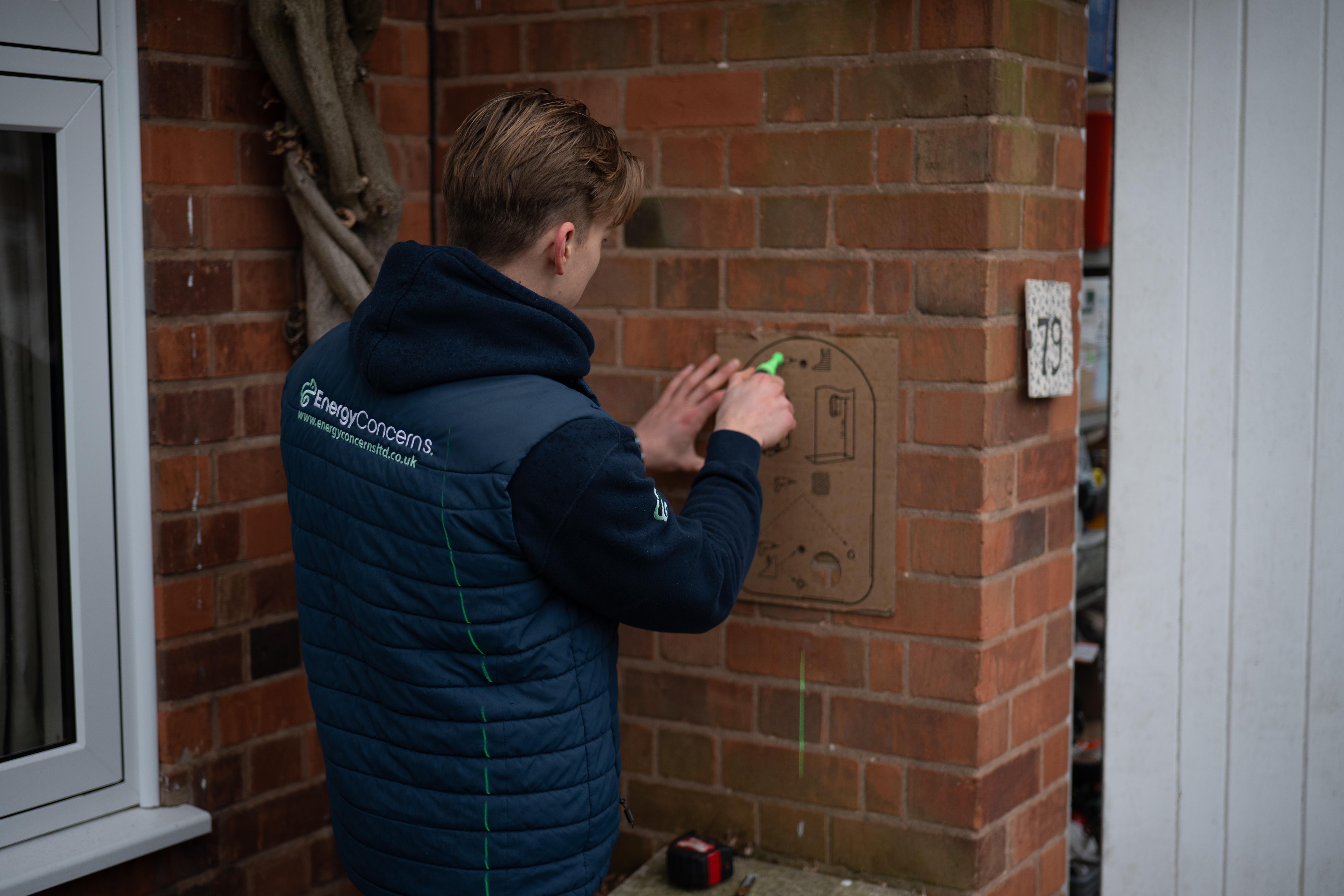
Leicester's Victorian and Edwardian terraces — the red-brick streets of Clarendon Park, the grand villas of Stoneygate, the bay-fronted homes of Evington — are some of the most characterful housing in the East Midlands. They are also, contrary to popular belief, very solar-friendly. The rear roof slopes that face away from the street are often ideal for panels, and much of the work is permitted development even inside a conservation area. But terraced roofs come with their own quirks: slate coverings, shared party walls, hipped and valley details, and Leicester City Council's heritage rules. This guide, from Leicester-based MCS-certified installer Energy Concerns Ltd (LE9), walks through roof types, planning, panel choices and realistic system sizes for a Leicester terrace in 2026.
Why Leicester's terraced housing suits solar better than you'd think
Drive down Clarendon Park Road, Queens Road or Francis Street and you'll see the archetypal Leicester terrace: two storeys, red Leicestershire brick, a pitched roof running the length of the row. The key point for solar is orientation. Most of these streets run so that each home has one roof slope facing the street and one facing the rear garden — and it's the rear slope that usually matters. Rear slopes are typically not visible from the highway, which keeps you within permitted development even in a conservation area, and they're often free of the bay-window and chimney clutter that breaks up a front elevation.Leicester sits in the East Midlands solar belt, where a well-oriented array yields roughly 950–1,050 kWh per kWp per year. A south or south-west-facing rear slope in Stoneygate or Evington will sit comfortably in that range. Even east–west splits on a terrace still perform well and spread generation across the morning and evening — handy when someone's home during the day. The unglamorous truth is that a plain Leicester terrace roof is often a better solar prospect than a fussy modern detached with dormers and rooflights.
Roof types on Leicester terraces — slate, valleys, hips and party walls
Terraced roofs bring specific structural considerations that a good surveyor will check before quoting:- Welsh slate and clay tile: Many pre-1919 Leicester terraces have natural slate; Edwardian homes often have clay tiles or later concrete replacements. Slate is brittle and needs careful fixing with the right hooks and flashings — a job for an installer who's worked on period roofs, not just new-build.
- Valleys and hips: End-of-terrace and villa properties in Stoneygate often have hipped or valley roofs, which shorten the usable panel run. We design around the valley rather than crowding it.
- Party walls and shared roofs: On a mid-terrace, your roof abuts your neighbours'. Panels stay well within your own roof plane, but scaffolding and access sometimes need a neighbour's cooperation — worth a friendly conversation early.
- Roof condition and age: A 100-year-old slate roof may need minor repair or re-battening before a 25-year system goes on top. It's far cheaper to fix a few slipped slates during install than to lift panels later.
Conservation areas and planning: Clarendon Park, Stoneygate and Evington
This is where local knowledge earns its keep. Much of eastern Clarendon Park and the villa streets around it fall within the Stoneygate Conservation Area, designated by Leicester City Council in 1978 and roughly bounded by Victoria Park Road, Queens Road, Stoneygate Road and Shirley Road. Parts of Evington have their own conservation designations too.The good news: being in a conservation area does not ban solar. Under permitted development, panels on a rear roof slope not visible from the highway are generally allowed, provided they project no more than 200mm from the roof surface and don't sit above the highest part of the roof (excluding the chimney). Panels on the front (principal) elevation or a side elevation visible from the road require planning permission in a conservation area.
One important local point: the Stoneygate Conservation Area is covered by an Article 4 Direction. In Stoneygate this specifically brings solar panels that would be visible from the street under planning control — so a road-facing array here needs a planning application even where it might not elsewhere. Crucially, it does not stop a discreet array on a rear slope that isn't visible from the highway, which remains the usual route for a Leicester terrace. Separately, listed buildings (Stoneygate contains a number of Grade II-listed villas) need both planning permission and listed building consent — permitted development doesn't apply at all. When in doubt, a quick check with Leicester City Council's planning team, or a pre-application enquiry, settles it before any scaffold goes up.
Choosing panels for a period roof — appearance matters here
On a conservation-sensitive street, how the array looks can matter as much as how it performs. For Leicester's slate and dark-tile terraces we usually specify all-black (mono) panels — black cells, black backsheet and a black frame — which sit far more discreetly on a slate roof than the older blue-cell panels with silver frames. Against natural Welsh slate the difference is striking; from the street a rear array is often barely noticeable.Options to weigh up:
- All-black on-roof panels: The standard, best-value choice. Modern 400–440W all-black modules give strong output and a clean look.
- In-roof (integrated) systems: Panels sit flush within the roof plane rather than on brackets above it. More expensive and best fitted during a re-roof, but they give the lowest profile — sometimes the deciding factor for a visible slope or a conservation officer.
- Solar slates/tiles: The most discreet and the most expensive; occasionally justified on a prominent listed elevation, rarely needed on a hidden rear slope.
Realistic system sizes and 2026 costs for a Leicester terrace
Terrace roof slopes are smaller than detached roofs, so system sizes are usually modest — and that's fine, because it matches typical household demand. Rough guide for a Leicester terrace:- Small rear slope: ~6–8 panels, around 2.5–3.5kWp.
- Typical Clarendon Park / Evington terrace: ~8–12 panels, roughly a 4kWp system.
- Larger end-of-terrace or Stoneygate villa: 12–16+ panels, 5–6kWp+, sometimes spread across two slopes.
Getting paid for export, and grants that actually exist
Once your system is running you can be paid for the electricity you send back to the grid through the Smart Export Guarantee (SEG). Rates vary by supplier — typically around 5–15p per kWh, with tariffs from the likes of Octopus and British Gas — and you must have an MCS-certified installation to qualify, which is exactly why using an MCS installer matters. A terrace with an east–west split often exports well because generation is spread across the day.On grants, it's important to cut through the noise. There is no domestic 'FETF' grant for home solar. What genuinely exists in 2026:
- ECO4 and the Warm Homes: Local Grant can fund solar for lower-income households and eligible properties in EPC bands D–G — relevant for some older, less efficient Leicester terraces.
- If you're a flat owner or renter, the EV chargepoint grant (~£500) replaced the old OZEV domestic scheme and can help with a home charger.
Running a terrace business from home? A note on commercial solar
Plenty of Leicester's terraces double as premises — a therapist's room, a small studio, a shop with a flat above on Queens Road or Evington's high street. If your solar is going onto a genuinely commercial building rather than a home, the tax picture is different and worth getting right.The 0% VAT rate applies to domestic installations only. Commercial installs pay VAT at the standard rate, though a VAT-registered business can usually reclaim it. On the plus side, businesses can claim capital allowances: solar qualifies under the Annual Investment Allowance (up to £1m of qualifying spend at 100% in the year), or otherwise attracts the 50% first-year allowance. Note that solar PV is a special-rate asset — it does not qualify for full expensing, so the reliefs differ from general plant and machinery. If your Leicester property sits somewhere between home and business, talk to us and your accountant early so the install is structured correctly from day one.
Frequently Asked Questions
Ready to get it installed?
Get your free, no-pressure quotation
Tell us what you’re interested in — solar, battery storage, EV charging or air conditioning — and we’ll come back with an itemised quote. No salesman, no obligation.
Usually yes. Panels on a rear roof slope that isn't visible from the highway are generally permitted development, even in the Stoneygate Conservation Area, as long as they project no more than 200mm and don't sit above the ridge. Stoneygate is covered by an Article 4 Direction that brings road-visible solar panels under planning control, so a front or road-facing slope will need planning permission — but a discreet rear array normally won't. Listed buildings (there are several in Stoneygate) also need listed building consent. We'll check your specific property against Leicester City Council's records before quoting.
Not when they're fitted correctly. Natural slate is brittle, so it needs the right hooks, flashings and careful handling — which is why we survey period roofs before install and factor in any minor repairs. A sound Leicester terrace roof will comfortably carry a modern array for its 25-year-plus lifespan.
Most terraces in Clarendon Park or Evington take around 8–12 panels on the rear slope — roughly a 4kWp system. Smaller slopes might take 6–8 panels; larger end-of-terrace homes and Stoneygate villas can take 12–16 or more, sometimes across two slopes.
A typical 4kWp system costs about £6,000–£8,000 installed and benefits from 0% VAT on domestic solar until 31 March 2027. At East Midlands yields it generates roughly 3,600–4,000 kWh a year, saving around £700–£1,100 depending on your usage and tariff, with a payback of about 6–9 years. You can also earn from exported power via the Smart Export Guarantee (around 5–15p/kWh), which requires an MCS-certified install.
Possibly. ECO4 and the Warm Homes: Local Grant can fund solar for lower-income households and eligible EPC D–G properties, which includes some of Leicester's older terraces. There is no domestic 'FETF' grant. Eligibility depends on income, benefits and your EPC — we'll tell you honestly whether a grant route applies before you commit to anything.
Free, no obligation
Ready to go solar in the East Midlands?
Energy Concerns is MCS certified, RECC registered, and 5-star rated. We cover all of the East Midlands and Warwickshire — book a free survey and we'll give you honest, personalised advice.