

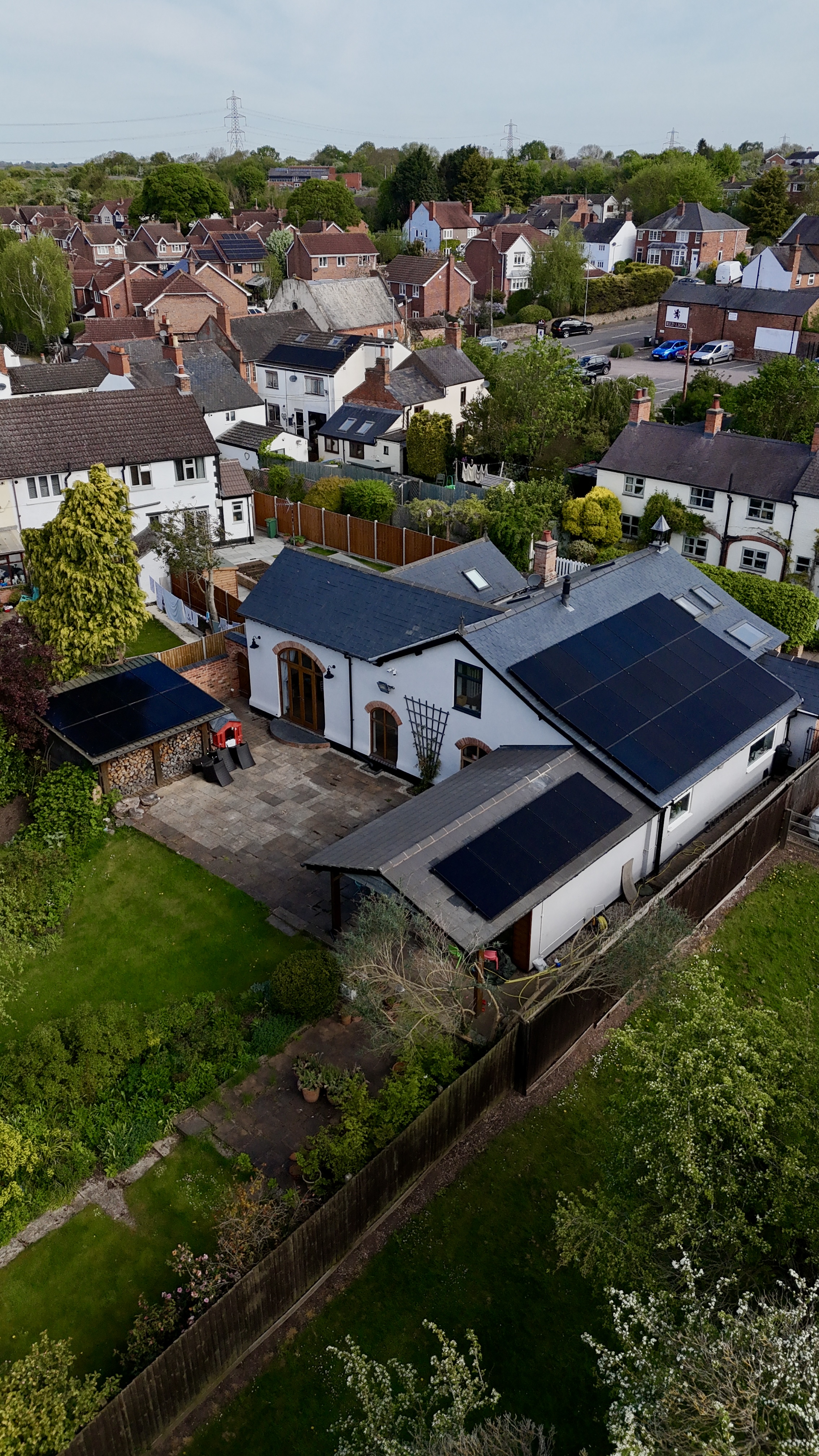
The number of solar panels you need depends on three things: how much electricity your household uses, how much of your roof is available and appropriately oriented, and whether you have additional electricity demands like an EV charger or battery storage. This guide walks through each factor clearly, with practical figures for the East Midlands based on our Leicester installations.
Step 1: Know Your Annual Electricity Consumption
The starting point for any solar system design is your household's annual electricity consumption in kilowatt-hours (kWh). You'll find this on your electricity bill or can check your smart meter's annual usage report.
| Household size | Property type | Typical annual usage |
|---|---|---|
| 1–2 people | Flat or small terraced | 1,500–2,000 kWh |
| 2–3 people | Terraced or small semi | 2,000–3,000 kWh |
| 3–4 people | 3-bed semi-detached | 3,000–4,000 kWh |
| 4–5 people | 4-bed detached | 4,000–5,500 kWh |
| Family + EV | Detached with EV charger | 6,500–9,000 kWh |
| Large/rural | Farmhouse or large detached | 7,000–12,000+ kWh |
Typical figures for East Midlands households. Add 3,000–4,000 kWh for each EV driven approximately 8,000–10,000 miles per year.
Step 2: Calculate the System Size You Need
In the East Midlands (including Leicestershire, Nottinghamshire, Derbyshire, and Northamptonshire), a standard solar panel rated at 400W will generate approximately 340–360 kWh per year in typical conditions. This assumes a south-facing roof at around 35° pitch with no significant shading.
Quick calculation formula
Annual usage (kWh) ÷ 350 kWh per panel = Number of panels needed
Example: 3,500 kWh ÷ 350 = 10 panels (a 4kW system)
For a self-consumption target of 70%: 3,500 × 0.7 ÷ 350 = 7 panels minimum
In practice, we recommend sizing your system slightly larger than your current consumption for two reasons: (1) electricity prices will likely continue rising, making self-generation increasingly valuable; and (2) future demands — an EV, a heat pump, or a growing family — are better anticipated at installation time than retrofitted later.
Step 3: How Many Panels Fit on Your Roof?
A standard 400W solar panel measures approximately 1.7m × 1.0m (1.7m²). Your usable roof area — accounting for chimneys, rooflights, access requirements, and ridge/eaves setbacks — determines your maximum system capacity.
| Property type | Typical roof area | Max panels | Max system |
|---|---|---|---|
| Mid-terrace (1 slope) | 15–20m² | 8–10 | 3.2–4kW |
| End-terrace / semi (2 slopes) | 25–40m² | 14–22 | 5.6–8.8kW |
| Detached (L-shaped or large) | 40–80m² | 22–44 | 8.8–17.6kW |
| Farmhouse / barn | 80–200m² | 44–110 | 17.6–44kW |
Usable area assumes standard setbacks from ridges, eaves, and obstructions. Energy Concerns assesses every roof individually — available space often differs significantly from total roof area.
Recommended System Sizes for East Midlands Homes
2-bed terraced / flat
2.4–3.2 kWPanels
6–8 panels
Annual generation
2,000–2,800 kWh/yr
Typical saving
£450–£620/yr
Best for: Single person or couple without EV
3-bed semi-detached
4–5.6 kWPanels
10–14 panels
Annual generation
3,400–4,800 kWh/yr
Typical saving
£750–£1,050/yr
Best for: Family of 3–4, most common configuration
4-bed detached
5.6–8 kWPanels
14–20 panels
Annual generation
4,800–6,800 kWh/yr
Typical saving
£1,050–£1,500/yr
Best for: Larger family, optional battery storage
Family home + EV
7.2–9.6 kWPanels
18–24 panels
Annual generation
6,100–8,200 kWh/yr
Typical saving
£1,350–£1,800/yr
Best for: Covers household + EV charging, ideal with battery
Rural / farmhouse
9.6–14.4 kWPanels
24–36 panels
Annual generation
8,200–12,300 kWh/yr
Typical saving
£1,800–£2,700/yr
Best for: Oil/LPG homes transitioning to heat pump + EV
Should I Include Battery Storage?
A battery storage system — such as GivEnergy or Growatt — stores surplus solar electricity generated during the day for use in the evening. Without a battery, your excess generation is exported to the grid (earning Smart Export Guarantee payments). With a battery, you use more of your own generation and reduce grid imports further.
Adding battery storage increases system cost by £3,000–£5,000 but extends self-sufficiency to evenings and can increase self-consumption from 35–40% to 70–80%. We generally recommend battery storage for households with above-average evening electricity usage, EV owners who charge overnight, or homes in areas with higher grid electricity costs.
Energy Concerns will always model both options — with and without battery — during your free survey, so you can make an informed decision based on your usage profile and financial priorities.
Get a Free, Bespoke System Design
Every Energy Concerns solar survey includes a detailed roof assessment, precise shading analysis using satellite data, system sizing recommendations, and a personalised financial projection — at zero cost or obligation. We design for your property and your usage, not for a generic household.
.jpg)