

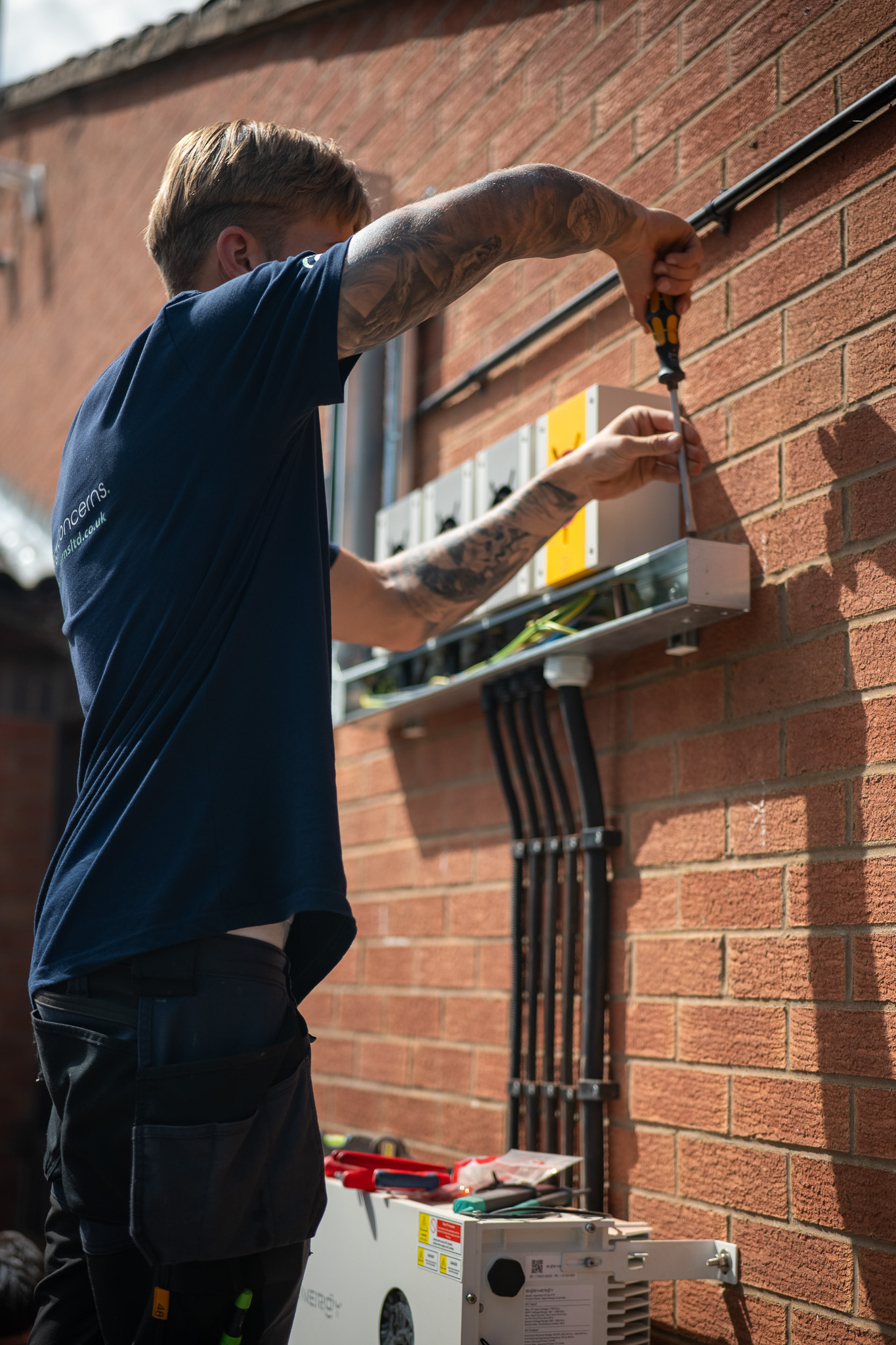
The Tesla Powerwall 3 has become the battery of choice for many Leicestershire homeowners pairing storage with solar. But the specifications, the true installed cost, and how it compares to alternatives like Sigenergy are widely misunderstood — and 2026 has brought a major shake-up in the battery market you need to know about. This guide, written by Energy Concerns Ltd, an MCS, RECC, NAPIT and TrustMark-certified family installer based in the LE9 postcode area near Leicester, walks through exactly how the Powerwall 3 works, its real capacity and power figures, what it costs to install here, how it performs during a power cut, and where it fits alongside solar in a typical Leicestershire home from Narborough to Market Harborough.
How the Tesla Powerwall 3 works
The Powerwall 3 is a lithium iron phosphate (LFP) home battery with something its predecessors lacked: a solar inverter built in. Earlier Powerwalls were AC-coupled, meaning your solar panels needed their own separate inverter and the battery added a second conversion stage. The Powerwall 3 is a hybrid DC-coupled system — your solar panels feed DC power straight into the Powerwall, which converts it once. That single conversion is why it reaches a round-trip efficiency of around 97%, among the best available.
In practice, the unit does three jobs at once. During the day it sends solar energy to power your home, stores the surplus, and only exports what is left over. In the evening it discharges to run your lights, appliances and TV instead of drawing from the grid. Overnight, if you are on a time-of-use tariff such as Octopus Go or Intelligent Octopus, it can charge from cheap off-peak electricity to use during peak hours. Everything is controlled through the Tesla app, which shows live generation, home use, battery level and grid flow — useful on the variable East Midlands weather days we get across Leicestershire.
Capacity and power: the real figures
Two numbers matter with any battery, and people routinely confuse them.
- Capacity (how much it stores): 13.5 kWh usable per Powerwall 3. That is enough to cover a typical evening and overnight run for most Leicestershire households — roughly a full day's electricity for an average home once solar tops it up.
- Power (how much it delivers at once): up to 11.04 kW continuous. This is where the Powerwall 3 pulls ahead of most rivals. High continuous output means it can run heavy loads — an electric shower, oven, kettle and EV charger — simultaneously without the grid stepping in.
Other verified specs: it accepts up to around 20 kW of solar input (so it comfortably handles a large roof array), weighs about 130 kg, carries an IP67 rating so it can be wall- or floor-mounted indoors or outdoors, and comes with a 10-year warranty. If you need more storage, units stack — two or three Powerwall 3s are common on larger properties or homes with a heat pump and EV.
What it costs in Leicestershire (2026)
A single Powerwall 3 typically starts from around £7,750 supplied and installed as a standalone battery retrofit, though the final figure depends on your consumer unit, cable runs and mounting location. As a rough industry benchmark, home battery storage works out at roughly £400–£700 per usable kWh, and the Powerwall 3's 13.5 kWh sits within that band once you account for its built-in inverter — which removes a cost you would otherwise pay separately.
Two points specific to 2026 make this a strong window:
- 0% VAT applies to domestic solar and battery installations until 31 March 2027, after which it rises to 5%. Installing before that deadline saves you the tax outright.
- If you fit the Powerwall alongside solar, the shared inverter means you are not paying twice for conversion hardware, so the combined price is better value than buying panels and a battery separately.
We provide fixed written quotes with no obligation — no vague 'from' pricing that changes on the day.
Backup power during a Leicestershire power cut
Storm-related outages do happen across rural Leicestershire — villages like Croft, Huncote and Sapcote, and the more exposed properties out toward Market Harborough and Lutterworth, occasionally lose supply. The Powerwall 3 supports whole-home or partial backup using a Backup Gateway, which detects a grid failure and switches your home over in a fraction of a second — fast enough that most people only notice because the app tells them.
What runs during an outage depends on the load. With up to 11 kW of continuous output, a single Powerwall can keep lights, fridge-freezer, broadband, heating controls and sockets going. Very high-draw items used together (an electric shower plus an oven plus EV charging) may exceed a single unit, which is one reason larger households opt for two Powerwalls. Crucially, if you have solar, the Powerwall 3 will recharge from your panels during a daytime outage — so a sunny day extends your backup indefinitely, unlike a battery that can only run down. It is worth being clear: standard grid-tied solar without a battery shuts off in a power cut for safety, so the battery is what actually keeps your lights on.
Pairing the Powerwall 3 with solar
The Powerwall 3 is designed to be the heart of a solar-plus-storage system, and pairing the two is where the economics come alive. The East Midlands yields roughly 950–1,050 kWh per kWp per year, so a typical 4 kW array on a Leicestershire roof generates around 3,800–4,200 kWh annually. A 4 kW system costs roughly £6,000–£8,000 and saves an average home around £700–£1,100 a year, with a payback of about six to nine years.
Without a battery, much of your midday solar is exported for a modest rate. With a Powerwall storing that surplus for the evening, you self-consume far more of what you generate — the difference between exporting at low pennies and avoiding buying at full peak price. On top of that, the Smart Export Guarantee (SEG) pays you for genuine surplus you do export, typically 5–15p per kWh depending on your supplier (Octopus and British Gas among others run SEG tariffs). To claim SEG your installation must be MCS-certified — which every Energy Concerns install is. Many Leicestershire homes combine solar, a Powerwall and a time-of-use tariff to charge cheaply overnight in winter and bank free solar all summer.
Powerwall 3 vs Sigenergy and Fox ESS (2026)
For new installations in 2026, the three brands East Midlands homeowners compare most are the Tesla Powerwall 3, Sigenergy and Fox ESS. A battery is a 10–15 year purchase, so the warranty and support behind it matter as much as the headline specs.
The strong choices for new systems are:
- Tesla Powerwall 3 — 13.5 kWh, up to 11 kW continuous, integrated inverter, ~97% efficiency, 10-year warranty and a mature app. Best for homes that want proven simplicity and high power output.
- Sigenergy SigenStor — a modular '5-in-1' stackable tower (inverter, battery, energy management and optional DC EV charging in one), with capacity built up from ~5–9 kWh modules to well over 40 kWh, three-phase options and vehicle-to-grid capability. Best for homes wanting maximum future expansion, or those adding an EV and heat pump.
- Fox ESS — a well-established manufacturer with modular LFP batteries from around 5 kWh upwards, competitive £/kWh and a well-regarded app. Best for homes that want strong value with the option to expand later.
As MCS-certified installers, we recommend by property, not by brand loyalty — the right answer depends on your roof, your loads and your plans.
Certified local installation across Leicestershire
Energy Concerns Ltd is a family-run installer based in the LE9 postcode area, which sits within the Blaby district — the council whose offices are in Narborough. We install across a roughly 30-mile radius of Leicester, covering Blaby-district villages such as Narborough, Enderby, Countesthorpe, Whetstone, Cosby, Blaby, Glen Parva, Kirby Muxloe and Leicester Forest East, the city of Leicester itself, and out through Oadby and Wigston, Market Harborough, Lutterworth, Hinckley and Loughborough.
We hold MCS, RECC, NAPIT and TrustMark accreditation — MCS is the certification you need to claim SEG payments, and it signals a properly assessed, standards-compliant install. On planning: solar panels are usually permitted development in England, so most Leicestershire homes need no planning permission. The exceptions are listed buildings, conservation areas (where a front or principal elevation facing a highway may need consent — relevant in parts of Market Harborough, Oadby and older village cores) and some flats. We always confirm your property's status with the local planning authority before work begins. To discuss a Powerwall 3 or a full solar-plus-storage system for your home, get in touch for a free, no-obligation quote.
Frequently Asked Questions
Ready to get it installed?
Get your free, no-pressure quotation
Tell us what you’re interested in — solar, battery storage, EV charging or air conditioning — and we’ll come back with an itemised quote. No salesman, no obligation.
A single Powerwall 3 typically starts from around £7,750 supplied and installed as a standalone retrofit, with the final price depending on your consumer unit, cable runs and mounting. Home batteries broadly run £400–£700 per usable kWh. Installing before 31 March 2027 means you pay 0% VAT rather than the 5% that applies afterwards. Fitting it alongside solar is better value because the built-in inverter is shared. We provide fixed written quotes.
Each Powerwall 3 stores 13.5 kWh of usable energy and delivers up to 11.04 kW of continuous power — enough to run heavy loads like a shower, oven and EV charger together. It accepts around 20 kW of solar input, weighs about 130 kg, is IP67-rated for indoor or outdoor mounting, and comes with a 10-year warranty. Units stack if you need more storage.
Yes, when fitted with a Backup Gateway it switches your home to battery power almost instantly during a grid outage. With up to 11 kW output a single unit runs lights, fridge-freezer, broadband and heating controls. If you also have solar, the Powerwall recharges from your panels during a daytime outage, extending backup on sunny days. Note that grid-tied solar without a battery shuts off in a power cut for safety.
For new systems the strong options are the Tesla Powerwall 3 (proven, high power, integrated inverter, 10-year warranty), the Sigenergy SigenStor (modular, highly expandable, with optional DC EV charging and vehicle-to-grid) and Fox ESS (modular LFP with competitive value and easy expansion). As MCS installers we recommend by your property and needs, not by brand.
Usually not — solar panels are permitted development across most of England, so the majority of Leicestershire homes need no planning permission. Exceptions include listed buildings, conservation areas (where a principal elevation facing a highway may require consent, as in parts of Market Harborough or older village cores) and some flats. We always confirm your property's status with the local planning authority before starting, and every install is MCS-certified so you can claim SEG export payments.
Free, no obligation
Ready to go solar in the East Midlands?
Energy Concerns is MCS certified, RECC registered, and 5-star rated. We cover all of the East Midlands and Warwickshire — book a free survey and we'll give you honest, personalised advice.