

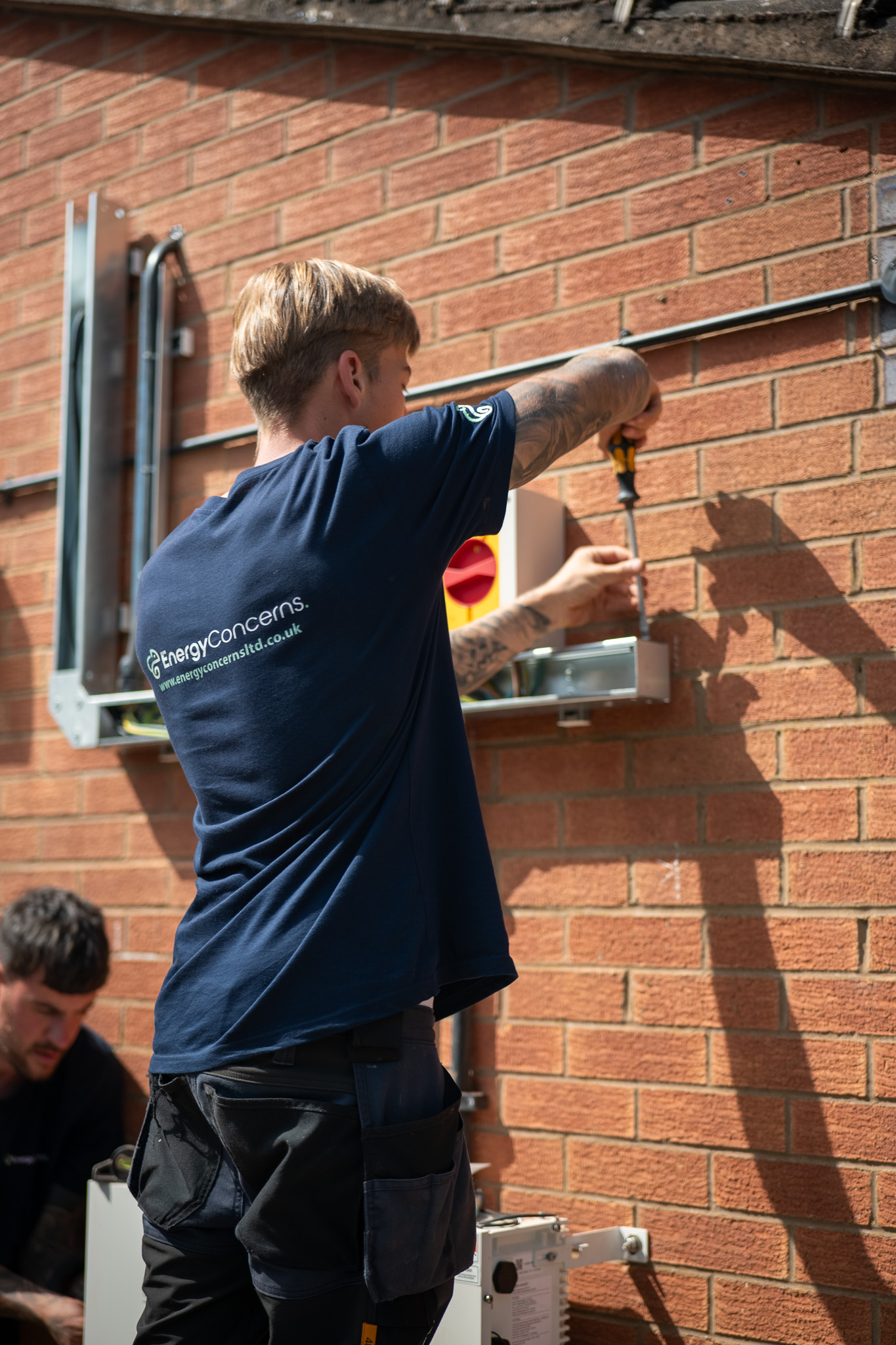
Syston sits just north of Leicester on the A607 (Melton Road) corridor, separated from the city only by Thurmaston, with the A46 Leicester Western Bypass running past its western edge. It is one of the busier towns in Charnwood Borough. Its mix of Victorian terraces near the High Street and railway station, interwar semis, postwar estates and newer developments around the edges makes it a strong candidate area for domestic solar. This guide, written by Energy Concerns Ltd, a Leicester-based (LE9) MCS-certified family installer working within about 30 miles of the city, covers realistic system sizes, 2026 costs and savings, battery storage, the Smart Export Guarantee and the local planning rules that apply in Syston and its surrounding villages.
Why Syston homes are well suited to solar
Syston (postcode LE7) is a town of roughly 12,800 people in the north of Charnwood Borough, sitting immediately north of Leicester with only Thurmaston between the two. Because most of the town's housing runs on modest 20th-century estates and older terraces, the majority of properties have their own roofs rather than shared blocks, which is exactly what makes rooftop solar straightforward.
The East Midlands is a genuinely viable region for solar. A well-oriented array here typically yields around 950-1,050 kWh per kWp installed per year. That is lower than the south coast but more than enough to make a system pay, especially with today's electricity prices. A south-facing roof is ideal, but east-west splits work well too and often suit Syston's estate housing, where roof ridges run in various directions.
Practical local factors matter more than headline sunshine figures: roof pitch, freedom from shading (mature trees are common on the older streets off High Street and around the church), and whether your loft or garage can house an inverter and battery. A proper site survey settles all of this before any quote is confirmed.
Typical system sizes for Syston housing stock
The right size depends on your roof area and how much electricity you use. As a rough guide for the property types you find across Syston:
- Victorian and Edwardian terraces (near the High Street, station and older streets): roof space is limited, so 2.5-4 kW (roughly 6-10 panels) is common.
- Interwar and postwar semis (the bulk of Syston's estates): a 4 kW system (around 10 panels) is the classic fit and a sensible default.
- Larger detached and newer executive homes (edge-of-town developments toward Queniborough, East Goscote and the Wreake villages): 5-6 kW or more, often paired with a battery.
A 4 kW array typically needs about 20-25 m2 of unshaded roof. Modern panels are around 430-450 W each, so fewer panels are needed than a decade ago. We size systems to your actual consumption and roof, not to a one-size-fits-all package, because oversizing a small terrace or undersizing a family home both waste money.
Costs and savings in 2026
For a typical Syston home, a 4 kW system costs roughly £6,000-£8,000 fully installed, including panels, inverter, mounting and MCS certification. Crucially, domestic solar and battery installations currently carry 0% VAT until 31 March 2027, after which VAT is expected to rise to 5%, so installing before that date saves you money directly.
Savings come from two sources: electricity you no longer buy from the grid, and payments for surplus you export. A 4 kW system typically saves around £700-£1,100 per year depending on your usage and how much of your generation you use during daylight hours. That points to a payback of roughly 6-9 years, after which the electricity is effectively free for the remaining life of the panels, which are usually warrantied for 20-25 years.
Self-consumption is the biggest lever. Running the washing machine, dishwasher or an EV charger during the day, rather than exporting that power cheaply, sharply improves your return. Households where someone is home during the day, or that add a battery, tend to sit at the higher end of the savings range.
Battery storage: is it worth it in Syston?
A battery stores the solar you generate during the day so you can use it in the evening, instead of exporting it and buying it back later at a higher price. This lifts self-consumption from a typical 30-50% up to 70-80% or more, which is where batteries earn their keep.
Expect to pay roughly £400-£700 per usable kWh of storage. A common domestic size is 5-10 kWh, so a battery commonly adds a few thousand pounds to a project. Like solar, batteries qualify for 0% VAT until 31 March 2027, whether fitted alongside new panels or retrofitted to an existing array.
A battery makes most sense if: you use a lot of electricity in the evenings, you want resilience, or you can pair it with a smart tariff. Time-of-use tariffs let you charge the battery from the grid overnight when rates are low and run the house from it during peak hours, on top of storing your own solar. For a smaller Syston terrace with modest generation, a battery may be optional; for a family home or a property with an EV, it usually strengthens the case.
Getting paid for exports: the Smart Export Guarantee
Any solar you generate but don't use can be sold back to the grid under the Smart Export Guarantee (SEG). Licensed suppliers pay you per kWh exported, and rates vary considerably, currently in the region of 5-15p per kWh depending on the supplier and tariff. Well-known options include Octopus and British Gas, but the market moves, so it pays to compare live rates when you switch.
To claim SEG you need two things: an MCS certificate for your installation (which we provide as an MCS-certified installer) and a smart or export meter to measure what you send back. You can be with one supplier for import and another for export, so you're free to choose the best export rate available to you.
Some of the highest export rates are tied to bundled import-and-export tariffs or come with conditions, so read the terms rather than chasing the top headline number alone. For most Syston households the practical aim is a good balance of a fair export rate and a competitive import tariff, combined with using as much of your own solar as possible.
Planning permission and conservation rules in Syston
In most cases, solar panels on a house in Syston are permitted development, meaning no planning application is needed, provided the standard conditions are met (panels sit close to the roof slope, don't project above the highest part of the roof, and so on). That covers the majority of the town's estate housing.
There are important exceptions to confirm before you proceed:
- The Syston Conservation Area (designated in 1975, covering the historic core around High Street and the Church of St Peter and St Paul): panels on a wall or roof slope that faces onto and is visible from a highway may need planning consent.
- Listed buildings anywhere in the town: listed building consent is required, and this is separate from planning permission.
- Some flats and maisonettes, where permitted development rights differ.
The local planning authority is Charnwood Borough Council. If your home is older, near the church or High Street, or you're unsure, always check with Charnwood before committing. The same principles apply in nearby villages such as Wanlip, Cossington, Barkby and Rearsby, which have their own historic cores. We're happy to advise on whether your specific roof is likely to be permitted development.
Grant funding for eligible Syston households
Solar isn't only for those paying up front. Two schemes can fund panels for lower-income households or homes with poorer energy efficiency:
- ECO4 — supplier-funded support running to December 2026, aimed at low-income and vulnerable households, which can cover solar and other efficiency measures.
- Warm Homes: Local Grant — council-delivered funding running to 2028, targeting lower-income homes in EPC bands D to G.
Eligibility depends on income, benefits and your property's EPC rating, and the schemes are delivered locally, so availability and exact terms in the Charnwood area can vary. Given that much of Syston's older terrace and interwar stock sits in the lower EPC bands, it's genuinely worth checking whether your home qualifies rather than assuming it doesn't. We can point you toward the right route based on your circumstances.
Why choose a local Leicester installer
Energy Concerns Ltd is a Leicester-based family firm in LE9, roughly nine miles from Syston and comfortably within our normal working radius of about 30 miles of the city. That proximity matters: it means quick site surveys, straightforward aftercare, and an installer who knows the local housing and the Charnwood planning context first-hand.
We're MCS certified, which is a requirement for you to claim the Smart Export Guarantee, and we hold RECC, NAPIT and TrustMark accreditations for consumer protection and quality. MCS certification also underpins your workmanship guarantees and gives suppliers confidence to pay your export payments.
Every project starts with a proper survey of your roof, shading and electricity usage, followed by a clear, itemised quote with no pressure. Whether you're in a terrace off High Street, a semi on one of the postwar estates, or a newer home toward East Goscote or Queniborough, we'll tell you honestly what size system suits your roof and budget, and what returns to realistically expect.
Frequently Asked Questions
Ready to get it installed?
Get your free, no-pressure quotation
Tell us what you’re interested in — solar, battery storage, EV charging or air conditioning — and we’ll come back with an itemised quote. No salesman, no obligation.
Usually no. Solar panels on most Syston homes are permitted development and need no planning application, as long as standard conditions are met. Exceptions include listed buildings, some flats, and properties in the Syston Conservation Area (around High Street and the Church of St Peter and St Paul) where panels visible from a highway may need consent. Always confirm with Charnwood Borough Council if you're unsure.
A typical 4 kW system for a Syston home costs around £6,000-£8,000 fully installed, with MCS certification included. Domestic solar and battery installations carry 0% VAT until 31 March 2027, after which VAT is expected to rise to 5%, so installing sooner saves money. Smaller terraces cost less; larger homes with batteries cost more.
A 4 kW system typically saves around £700-£1,100 per year for a north Leicester home, giving a payback of roughly 6-9 years. Savings depend on how much solar you use directly versus export. Using appliances during daylight, or adding a battery, pushes you toward the higher end. Panels are usually warrantied for 20-25 years, so most of that time the electricity is effectively free.
Often yes, particularly for family homes or households that use most of their electricity in the evening. A battery stores daytime solar for later use, lifting self-consumption from around 30-50% to 70-80% or more. Batteries cost roughly £400-£700 per usable kWh and, like solar, qualify for 0% VAT until 31 March 2027. For a small terrace with modest generation, a battery may be optional.
Syston falls under Charnwood Borough Council, the local planning authority for the north of Leicestershire. Syston also has its own town council. For any query about permitted development, conservation area rules or listed buildings, Charnwood Borough Council is the body to contact before you install.
Yes. Energy Concerns Ltd is based in Leicester (LE9), about nine miles from Syston, and works within roughly 30 miles of the city. That includes Syston (LE7) and nearby villages such as Thurmaston, Wanlip, Cossington, Barkby, Queniborough, East Goscote, Rearsby and Ratcliffe-on-the-Wreake. We're MCS, RECC, NAPIT and TrustMark accredited.
Free, no obligation
Ready to go solar in the East Midlands?
Energy Concerns is MCS certified, RECC registered, and 5-star rated. We cover all of the East Midlands and Warwickshire — book a free survey and we'll give you honest, personalised advice.