

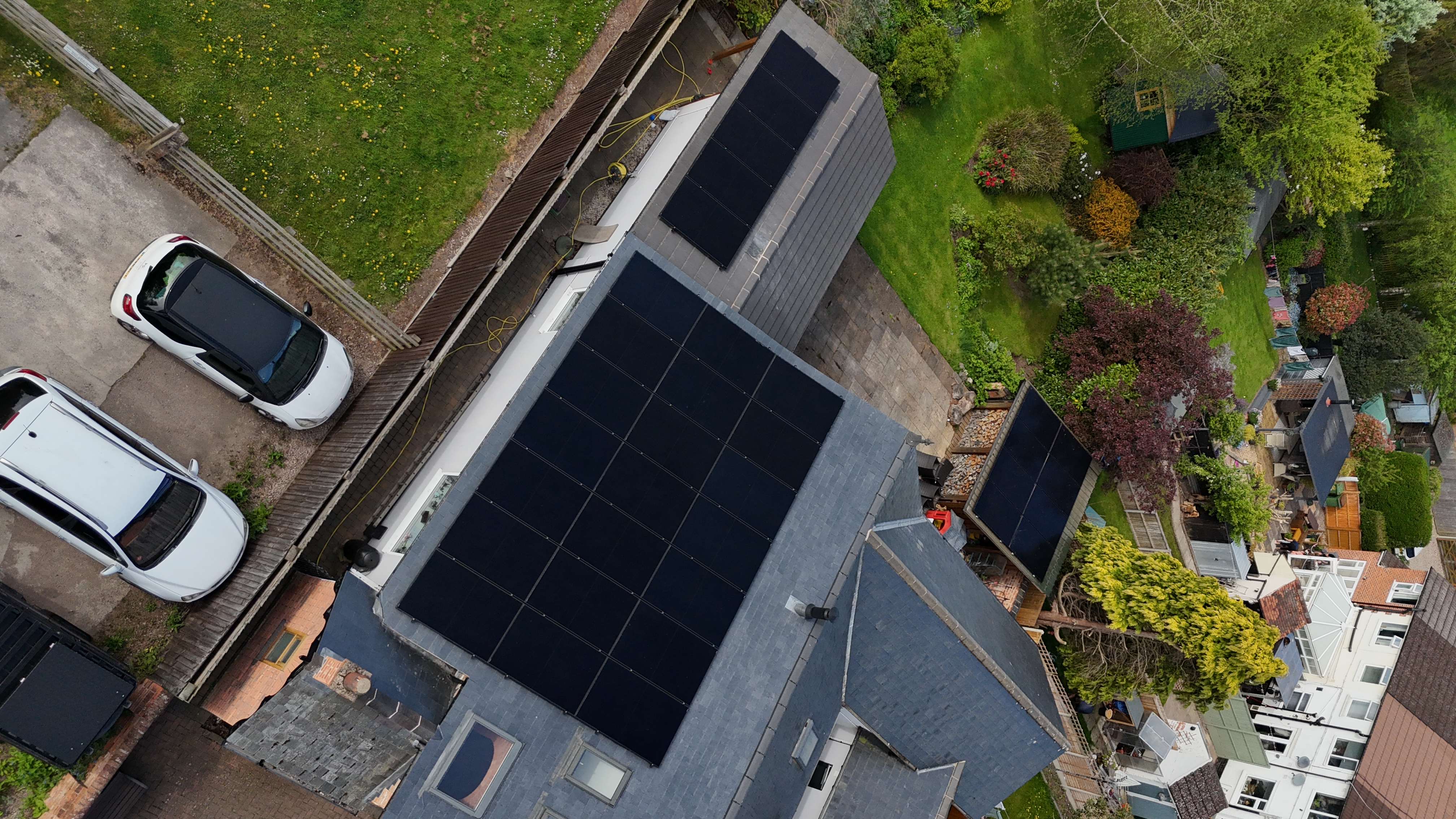
Lutterworth is a handsome south Leicestershire market town — a medieval High Street, a Grade II Town Hall, and a fast-growing rural surround that runs out to Magna Park, one of Europe's largest logistics parks. If you own a home here in the LE17 postcode, from a Georgian townhouse near St Mary's Church to a modern detached on the newer estates off Lutterworth Road and Bitteswell Road, solar panels are one of the few home upgrades that pay you back. This guide covers exactly what matters locally: which council rules apply (Harborough District Council), how conservation-area and listed-building status affects permitted development, what different Lutterworth roof types mean for an array, realistic 2026 costs and savings for the East Midlands, battery storage, the grants that exist, and honest expectations for winter output. It is written for Lutterworth homeowners by Energy Concerns Ltd, a Leicester-based (LE9) MCS-certified installer working right across South Leicestershire.
Why solar makes sense for Lutterworth homes
Lutterworth sits in South Leicestershire, roughly midway between Leicester, Rugby and Market Harborough, straddling the M1 and the River Swift. It is a town of contrasts for solar: the historic core around the High Street, Church Street, Market Street and Bell Street is dense and old, while the surrounding growth — the estates off Lutterworth Road, Bitteswell Road, Coventry Road and Gilmorton Road, plus the ongoing expansion toward Magna Park — is largely modern housing with simple, well-oriented roofs.
That matters because roof suitability drives everything. The East Midlands receives roughly 950–1,050 kWh of solar generation per kWp installed each year, which is a genuinely productive band for the UK. A south, south-east or south-west facing roof with minimal shading — common on the newer Lutterworth estates — will sit at the top of that range. Even east–west split roofs, which many detached and semi-detached homes here have, perform well by spreading generation across the morning and afternoon.
Electricity prices remain high and volatile, and generating your own daytime power is the most direct hedge a homeowner has. Combined with the Smart Export Guarantee paying you for surplus and 0% VAT until 2027, the economics for a typical Lutterworth home are the strongest they have been. See also: our residential solar installations.
Planning permission: Harborough District Council, conservation areas & listed buildings
Your local planning authority is Harborough District Council, not Leicester City. This is the office that governs solar permissions across Lutterworth and the surrounding villages such as Bitteswell, Gilmorton, Ullesthorpe and Bruntingthorpe.
The good news: for the large majority of Lutterworth homes, roof-mounted solar is 'permitted development' and needs no planning application. The standard conditions are straightforward — panels must not project more than 200mm from the roof slope, must not sit above the highest part of the roof, and should be removed when no longer needed. Most installations on standard pitched roofs comfortably meet these.
The exceptions are important in a historic market town:
- Listed buildings. Lutterworth has a genuine stock of listed properties, from the Grade II Town Hall on the High Street to numerous listed houses on Market Street, Church Street and George Street. If your home is listed, you need listed building consent for solar — regardless of where the panels go — before any work starts.
- The Lutterworth Conservation Area. This designation covers much of the medieval core around St Mary's Church, the High Street and the market area. In a conservation area the national rule only excludes panels on a wall, balcony or roof enclosure that fronts a highway; roof slopes, including street-facing ones, are not restricted by it, though a flat-roof array needs prior approval and an Article 4 direction can add controls.
- Flats and maisonettes generally do not benefit from the same permitted-development rights as houses.
If you are in the older part of town, do not assume — and equally, do not be put off. Many conservation-area homes have solar on a roof slope without needing an application. Energy Concerns can check your address against Harborough's mapping and, where consent is needed, prepare the application. Ask us to check your address.
Lutterworth roof types and what they mean for your array
Lutterworth's housing spans centuries, and roof type changes the design of every system. Here is how the common local stock stacks up.
Georgian and Victorian townhouses (High Street, Market Street, Bell Street). Often steep slate roofs, sometimes with chimneys and dormers that create shading and cut usable area. Many are listed or in the conservation area, so a rear-slope design is usually the route. Slate needs careful fixing but is entirely workable for an experienced installer.
Inter-war and post-war semis (Coventry Road, Leicester Road corridors). Typically concrete-tile or clay-tile pitched roofs with good south or east–west aspects and few obstructions — often the easiest and most cost-effective installs in town.
Modern detached and estate homes (off Lutterworth Road, Bitteswell Road, Gilmorton Road and the newer developments). Concrete interlocking tiles, generous roof spans and simple geometry. These frequently support 5–6kW-plus arrays and are ideal candidates for adding a battery.
Rural properties and converted barns in the surrounds (Bitteswell, Ullesthorpe, Bruntingthorpe). May have large outbuilding or barn roofs — sometimes with the space for a bigger system — but watch for older structures, mixed roof coverings and any listed status.
Whatever the roof, a proper MCS survey checks structural condition, orientation, pitch, shading from trees or neighbouring buildings, and how the panels tie into your loft and consumer unit. See also: pairing solar with battery storage.
Costs and savings in 2026 for a Lutterworth home
Here are realistic 2026 figures for the East Midlands, with 0% VAT already applied (domestic solar and battery are zero-rated until 31 March 2027, after which VAT rises to 5%).
| System size | Typical Lutterworth home | Indicative cost | Estimated annual saving | |---|---|---|---| | 4kW (~10 panels) | 3-bed semi | £6,000–£8,000 | £700–£1,100 | | 5–6kW (~13–15 panels) | 4-bed detached | £8,000–£11,000 | £900–£1,400 | | Solar + battery | Detached with EV/high evening use | +£400–£700 per usable kWh | Higher self-consumption |
A 4kW system typically pays for itself in around 6–9 years, then delivers many more years of near-free daytime electricity — panels are usually warrantied for 25 years or more.
Your savings come from two streams. First, the electricity you generate and use yourself, which you no longer buy from your supplier. Second, the Smart Export Guarantee (SEG), which pays you for surplus you export. SEG rates vary widely by supplier, currently roughly 5–15p/kWh — Octopus Outgoing pays around 12p/kWh and British Gas has offered around 15p/kWh for domestic customers. You need an MCS certificate and a smart meter to claim, and you can take your SEG payments from a different company than the one you buy power from.
Battery storage: getting more from every panel
Solar generates most in the middle of the day, but most Lutterworth households use most of their electricity in the evening. A battery bridges that gap — storing your surplus so you use it at 7pm instead of exporting it cheaply and buying it back expensively later.
Battery storage costs roughly £400–£700 per usable kWh, and like solar it is zero-rated for VAT until March 2027. For a typical family home, a battery in the 5–10kWh range is common. The bigger win is often combining a battery with a smart, time-of-use tariff: you charge from cheap overnight electricity, top up from your panels by day, and largely avoid peak-rate imports. This is particularly valuable through the darker months, when only around 15–20% of a system's annual output arrives across November to February.
Batteries also add resilience and are a natural fit if you have — or plan to add — an EV charger, which many households on Lutterworth's newer estates already run. See also: EV charging with solar, our battery storage options.
Grants and support available in 2026
There is no universal cash grant for solar in England in 2026, but genuine support exists — and the tax break is significant.
- 0% VAT. All domestic solar PV and battery storage is zero-rated for VAT until 31 March 2027 (rising to 5% afterwards). On a £7,000 install that is a real saving versus the old 20% rate — effectively a built-in discount for acting before the deadline.
- ECO4. A supplier-funded scheme running to December 2026, aimed at low-income households and those with less energy-efficient homes (broadly EPC D–G). Eligibility is means- and property-tested.
- Warm Homes: Local Grant. Council-delivered funding running to 2028 for lower-income households in EPC D–G homes. Harborough District Council administers local delivery for Lutterworth residents, so eligibility and rollout depend on the council's scheme.
- Smart Export Guarantee. Not a grant, but ongoing income for exported electricity — the closest thing to a recurring subsidy, and it requires MCS certification.
Grant schemes have strict, changing eligibility rules. Energy Concerns can tell you honestly whether you are likely to qualify rather than promising funding that may not apply. Check your grant eligibility.
Why choose an MCS installer, and why Energy Concerns
Two accreditations matter above all: MCS and being able to issue the MCS certificate. Without an MCS-certified install you cannot claim the Smart Export Guarantee, and MCS is the mark most reputable insurers, mortgage lenders and future buyers look for.
Energy Concerns Ltd is a Leicester-based (LE9) family installer with MCS certification, backed by RECC, NAPIT and TrustMark membership — the accreditation stack that underpins consumer protection, workmanship warranties and deposit safeguards on UK solar. Being just up the road in LE9 means Lutterworth is firmly on our doorstep: local surveys, local aftercare, and genuine familiarity with Harborough District Council's requirements and the town's mix of conservation-area, listed and modern housing.
What a proper local process looks like:
1. Free roof and address check — orientation, shading, structure, and whether conservation-area or listed status applies. 2. A clear, itemised quote priced against your actual roof, with 0% VAT applied and honest savings and payback figures. 3. MCS-certified installation by our own team, with certification, DNO notification and SEG paperwork handled for you. 4. Aftercare from a company that is minutes away, not a national call centre.
If you own a home in Lutterworth or the surrounding villages and want a straight answer on whether solar stacks up for your roof, get in touch. Request your free Lutterworth solar quote.
Frequently Asked Questions
Ready to get it installed?
Get your free, no-pressure quotation
Tell us what you’re interested in — solar, battery storage, EV charging or air conditioning — and we’ll come back with an itemised quote. No salesman, no obligation.
For most homes in Lutterworth, no. Roof-mounted solar panels are usually 'permitted development' and do not need a planning application, provided they do not project more than 200mm from the roof slope and sit below the highest part of the roof. The main exceptions are listed buildings and properties in the Lutterworth Conservation Area — which covers much of the High Street, Church Street and Market Street area around St Mary's Church and the Grade II Town Hall. In a conservation area the national rule only excludes panels on a wall, balcony or roof enclosure that fronts a highway, so roof slopes are not restricted by it, though a flat-roof array needs prior approval and an Article 4 direction can add controls. If your home is listed, you will need listed building consent regardless of position. Energy Concerns can check your specific address against Harborough District Council's records before you commit. When in doubt, a quick call to Harborough's planning team settles it.
A typical 4kW system on a Lutterworth home costs roughly £6,000–£8,000 fully installed, and thanks to the 0% VAT on domestic solar and battery storage (in place until 31 March 2027) there is no VAT to add on top. Larger 5–6kW arrays common on detached homes in areas like Bitteswell Road or the newer estates off Lutterworth Road run higher, and adding a battery typically costs around £400–£700 per usable kWh. Exact pricing depends on your roof type, panel count, scaffolding access and whether you add a battery, so an MCS installer like Energy Concerns will quote against your actual roof rather than a generic figure.
A well-sited 4kW system in Lutterworth typically saves around £700–£1,100 a year, combining money you no longer pay your supplier for daytime electricity plus income from the Smart Export Guarantee (SEG) for surplus you send back to the grid. The East Midlands gets roughly 950–1,050 kWh of generation per kWp installed each year, which is solid for the UK. With payback usually in the 6–9 year range and panels warrantied for 25 years or more, most Lutterworth households see many years of near-free daytime electricity after the system has paid for itself. Adding a battery increases self-consumption and can push annual savings higher, especially if you also charge on a cheap overnight tariff.
The Smart Export Guarantee pays you for surplus electricity you export to the grid, and rates vary a lot by supplier — currently roughly 5–15p per kWh. At the higher end, Octopus Outgoing pays around 12p/kWh and British Gas has offered around 15p/kWh for domestic customers. You do not have to buy your electricity from the same company that pays your SEG, so it is worth shopping around. To claim any SEG tariff your system must be installed by an MCS-certified company and you need an MCS certificate — which is exactly what Energy Concerns provides as an MCS-registered installer. A smart meter is also required so your exports can be measured accurately.
Yes. Solar panels generate from daylight, not direct sunshine, so they still produce electricity on the overcast days Lutterworth sees plenty of — just at reduced output. The honest caveat is seasonality: UK winter output is much lower, with only roughly 15–20% of a system's annual generation falling across November to February, and the bulk arriving in the brighter spring and summer months. That is why pairing solar with a battery and a smart tariff makes sense — you store cheap or self-generated power to cover the darker months and evenings, rather than relying on winter sun alone.
Free, no obligation
Ready to go solar in the East Midlands?
Energy Concerns is MCS certified, RECC registered, and 5-star rated. We cover all of the East Midlands and Warwickshire — book a free survey and we'll give you honest, personalised advice.