

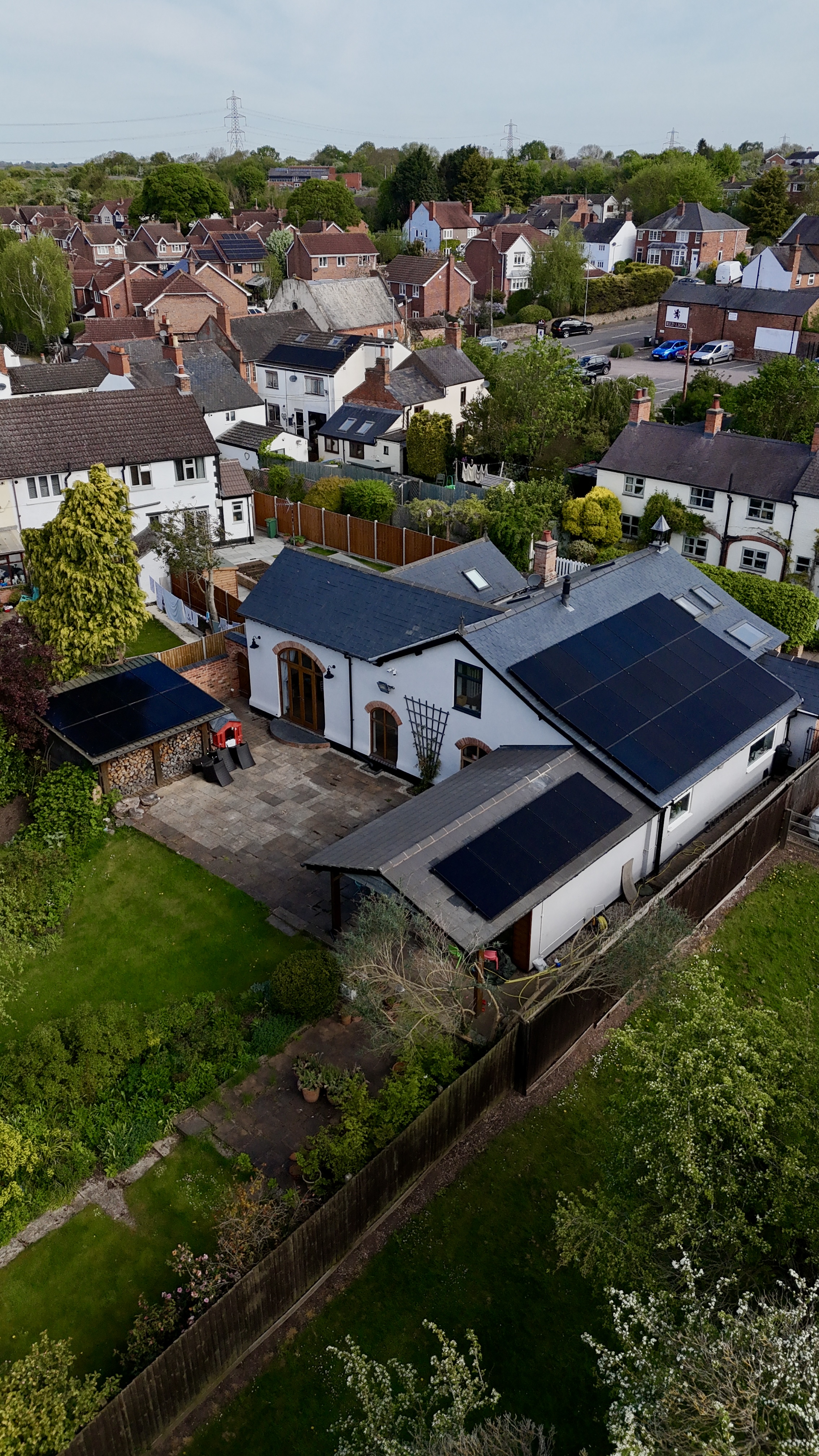
It is the single most common question we hear on driveways across Blaby, Narborough, Cosby and Broughton Astley: "This is Leicestershire — will solar panels actually do anything in a grey British winter?" It is a fair question. Anyone who has scraped ice off a windscreen in Enderby in January knows the East Midlands is not the Costa del Sol. The honest, non-salesy answer is: yes, solar panels genuinely work here in winter and on cloudy days — but not equally across the year, and understanding that seasonal split is the difference between a system that quietly saves you money and one that disappoints you. Solar panels run on daylight, not direct sunshine, so they keep generating under overcast Midlands skies — just at a reduced rate. This guide sets out the real numbers for a Leicestershire home: how your generation splits across the seasons, why "daylight not sunshine" matters, roughly what a typical Leicestershire roof produces in the depths of winter, and how a battery plus the right export tariff lets you bridge the dark months without shivering in the dark. We are Energy Concerns Ltd, an MCS-certified installer based in Leicester LE9, and everything below is written for real roofs in our patch — not a glossy brochure.
The short answer: yes, but the year is lopsided
Solar panels absolutely work in the East Midlands through winter and cloud — but you have to accept that generation is heavily front-loaded into the brighter half of the year. Across a full year, a typical Leicestershire roof produces somewhere in the region of 950–1,050 kWh for every kWp of panels installed (a standard 4kW system therefore lands around 3,800–4,200 kWh a year). The catch is that this yield is spread very unevenly. Roughly 15–20% of your entire annual generation falls in the four darkest months — November, December, January and February combined. Put the other way round: about 80–85% of what your panels make arrives between March and October.
This is not a fault in the panels or a Leicestershire-specific curse — it is simply how the sun sits in the sky at our latitude. In late June the sun climbs high and the days near Leicester stretch past 16 and a half hours; around the winter solstice in December we get under 8 hours of daylight and the sun barely lifts above the rooftops. Fewer daylight hours, at a shallower angle, through more cloud, equals far less energy. A well-designed system leans into this reality rather than pretending it does not exist: it is sized to make the most of the generous March-to-October window, and paired with a battery and a smart tariff to cover the lean months. The panels do not switch off in winter — they just contribute a smaller slice, and the rest of your strategy picks up the slack.
Daylight, not direct sun: why grey days still generate
The single most useful thing to understand about solar is that photovoltaic (PV) panels convert daylight into electricity — not direct, blazing sunshine specifically. Daylight is still reaching your roof on an overcast day in Countesthorpe; the clouds scatter and diffuse it rather than blocking it entirely. Your eyes adjust so a grey day feels merely 'dull', but there is still a great deal of usable light energy falling on the panels. That is why a solar array on a Whetstone semi keeps feeding power to the house even when the sky is a flat sheet of Leicestershire cloud.
The trade-off is output. On a bright, clear day a panel might run near its rated capacity; under heavy overcast that can fall to roughly 10–25% of peak, and on a genuinely dark, stormy afternoon lower still. So the panels are always working — the dial just moves. Two winter quirks actually help us here. First, PV cells are more efficient when they are cold, so a crisp, bright February morning in Broughton Astley can produce surprisingly strong output for the hour or two the sun is out. Second, panels are mounted at a tilt, so light snow tends to slide off, and their dark surface warms and clears fairly quickly. The practical upshot for an East Midlands home: do not judge your system by a single grim December afternoon. Judge it across the day and across the year, where the diffuse light on hundreds of cloudy-but-bright days adds up to a meaningful chunk of your annual total.
Real Leicestershire winter output: what your roof actually makes
Let us put numbers on it for a real local home. Take a common setup for our patch — a 4kW array (about ten panels) on a south-facing roof in Cosby or Huncote. Over the year that system makes roughly 3,800–4,200 kWh. Here is how a typical year tends to break down around Leicester:
- Peak summer (May–July): a strong sunny day can produce 20–28 kWh, and these are the months carrying the bulk of your annual yield.
- Spring and autumn (Mar–Apr, Sep–Oct): solid, dependable generation — often 8–16 kWh on a decent day.
- Deep winter (Nov–Feb): this is where expectations need to be realistic. A bright, cold winter day might give you 4–8 kWh, while a dark, heavily overcast December day can drop to 1–3 kWh. December is routinely the weakest month of all, sometimes producing only around a tenth of what July delivers.
Across those four winter months combined, a 4kW Leicestershire system typically generates in the region of 550–800 kWh — the 15–20% of the annual total mentioned earlier. That is still a genuinely useful amount: enough to cover a fair share of your daytime background load (fridge, freezer, router, standby, the odd wash) on many days, trimming what you draw from the grid at exactly the time of year bills are highest. Your exact figures depend on roof orientation, pitch, and shading from trees or neighbouring properties — a chimney or a tall conifer in a Huncote garden can matter more than the weather. That is precisely what an MCS installer models in a proper site survey before quoting, rather than quoting a generic 'up to' headline.
Batteries: storing the good months to soften the dark ones
A battery does not create energy — it moves it in time, and that is exactly the lever winter needs. Even in the darker months your panels usually generate most of their electricity in the middle of the day, when many people in Enderby or Sapcote are out at work or school and household demand is low. Without storage, that midday surplus gets exported to the grid, and you then buy expensive power back in the dark evening peak. A home battery captures the daytime generation and releases it in the evening when the kettle, oven, TV and lights are all running — so more of your own free solar is actually used in your own home instead of sold cheaply and bought back dearly.
Batteries typically cost in the region of £400–700 per usable kWh of capacity, and for most Leicestershire homes something in the 5–10 kWh range is the sweet spot. The clever winter move is to combine a battery with a time-of-use import tariff (see the next section). On the shortest December days your panels may not fill the battery on their own — but you can charge it from the grid overnight when electricity is cheapest, then run the house off stored power through the pricey evening peak. That turns your battery into a year-round money-saver, not just a summer solar sponge. One honest caveat: a battery adds cost and lengthens payback, so it is not right for every household. It makes most sense if you are often out during the day, have higher evening usage, or want more resilience. We will always model it both ways so you can see the numbers before deciding.
Export tariffs (SEG): getting paid for your summer surplus
When your panels make more than the house and battery can use — which happens constantly across the bright half of the year — that surplus flows to the grid, and you should be paid for it. This is the Smart Export Guarantee (SEG), and having an MCS-certified installation (which is exactly what we provide) is a requirement to access it. SEG rates vary quite a bit by supplier, generally landing anywhere from around 5p up to about 15p per kWh, so the tariff you choose materially affects your return.
As of 2026, two options stand out for a typical domestic home. Octopus Energy's Outgoing tariff pays a flat rate — currently around 12p per kWh after a change in March 2026 — and pairs neatly with their cheap overnight import rates, which is ideal if you have a battery. British Gas has offered one of the highest headline domestic SEG rates at around 15p per kWh; note that a widely reported 8p rate applies only to larger systems above 15kW, not to a normal home array. The smart play for most Leicestershire households is to bank strong export income across March–October, when you are generating far more than you can use, and lean on a battery plus a cheap overnight tariff to get through the winter economically. Do not obsess over squeezing the last penny from a dark December export figure — the real money is made by capturing summer surplus at a good rate and shifting cheap off-peak power in winter. Because SEG offers change regularly, it is worth reviewing your tariff each year; we are happy to point you at the current best fits.
The 2026 money picture: costs, savings and grants for Leicestershire homes
For a Leicestershire household weighing this up in 2026, here is the grounded financial picture. A typical 4kW system costs in the region of £6,000–8,000 fully installed, and there is currently 0% VAT on domestic solar and battery installations until 31 March 2027 (after which it is due to rise to 5%) — so getting your install completed before that deadline saves you real money. A well-designed 4kW system in our area saves roughly £700–1,100 a year on electricity and export income combined, giving a payback period of around 6–9 years, after which the savings are essentially free electricity for the remaining 15-plus years of the panels' life.
There is also grant support worth checking. ECO4 (supplier-funded, running to December 2026) and the Warm Homes: Local Grant (council-funded, running to 2028) can help lower-income households, and those in EPC band D–G properties, with the cost of solar, batteries and other efficiency measures. The Warm Homes: Local Grant is administered by your local district council — Blaby District Council covers villages such as Cosby, Countesthorpe, Whetstone, Kirby Muxloe, Sapcote and Stoney Stanton, while Harborough District Council covers Broughton Astley — so eligibility and application routes are worth confirming for your specific address.
One planning point that reassures a lot of homeowners in Whetstone or Kirby Muxloe: solar panels are usually permitted development, meaning no full planning application is needed for a standard roof install. The main exceptions are listed buildings, homes in conservation areas (particularly where panels would sit on a principal elevation facing a highway) and some flats — so if your property is listed or in a designated area, that is the one thing to check first. For everyone else, the paperwork is refreshingly light.
Getting it right for your Leicestershire roof
The reason winter and cloud spook people is usually a badly designed system, not a limitation of solar itself. A system sized purely on a summer fantasy, mounted on a shaded or awkwardly oriented roof, will underwhelm in December and sour the whole experience. A system designed properly for the East Midlands — sized to harvest the strong March-to-October window, paired sensibly with a battery, and matched to a good import and export tariff — behaves exactly as promised through every season, including the grey ones.
That design work is what MCS certification exists to protect. As an MCS-certified installer (also RECC, NAPIT and TrustMark accredited) based in Leicester LE9, Energy Concerns Ltd surveys the actual roof: its true orientation and pitch, shading from trees, chimneys and neighbouring buildings across the seasons, your household's real usage pattern, and whether a battery genuinely pays for you. From that we model honest year-round generation and savings figures for your address — not a generic headline. We serve homeowners right across the Blaby district and the wider Leicester and Leicestershire area, from Enderby and Narborough to Cosby, Countesthorpe, Sapcote and Stoney Stanton, as well as neighbouring Broughton Astley in the Harborough district. If you have been putting off solar because you were not sure it would work in a British winter, the answer is that it does — you just want it designed by someone who plans for the dark months rather than hoping they will not come. That is exactly what we do.
Frequently Asked Questions
Ready to get it installed?
Get your free, no-pressure quotation
Tell us what you’re interested in — solar, battery storage, EV charging or air conditioning — and we’ll come back with an itemised quote. No salesman, no obligation.
No. Solar panels run on daylight rather than direct sunshine, so they keep generating on cloudy East Midlands days — just at a reduced rate. Under heavy overcast, output can fall to roughly 10–25% of peak, but the panels never switch off during daylight. Across many cloudy-but-bright days through the year, that diffuse light adds up to a meaningful share of your total generation.
Expect the four darkest months (November to February) to produce only about 15–20% of your annual total. A typical 4kW Leicestershire system might make 4–8 kWh on a bright cold winter day, dropping to 1–3 kWh on a dark, heavily overcast December day. Over the whole winter those four months together generate roughly 550–800 kWh — still enough to offset a useful chunk of your daytime background usage when bills are at their highest.
For many households, yes. A battery stores your midday generation (when the house is often empty) and releases it during the expensive evening peak, so you use more of your own solar. In winter you can also charge it overnight on a cheap off-peak tariff and run the house from stored power through the pricey evening — turning it into a year-round saver. Batteries cost around £400–700 per usable kWh; a 5–10 kWh unit suits most Leicestershire homes. It suits you best if you are out during the day or have high evening use, and we will model the numbers both ways before you decide.
A typical 4kW system costs around £6,000–8,000 fully installed, with 0% VAT on domestic solar and battery until 31 March 2027 (rising to 5% after). A well-designed system in our area saves roughly £700–1,100 a year across bill savings and export income, giving a payback of about 6–9 years — after which you enjoy largely free electricity for the panels' remaining 15-plus years.
Yes, through the Smart Export Guarantee (SEG), which requires an MCS-certified installation like ours. Rates vary by supplier, generally from around 5p up to about 15p per kWh. In 2026, Octopus Outgoing pays around 12p per kWh (great alongside a battery and cheap overnight import), and British Gas has offered around 15p for domestic systems — note its 8p rate applies only to larger systems above 15kW. Most of your export income is earned across the bright March-to-October months.
Usually not. Solar panels are normally permitted development for standard roof installs, so no full planning application is needed. The main exceptions are listed buildings, properties in conservation areas (especially where panels face a highway on the principal elevation) and some flats. If your home is listed or in a designated area, check that first — for most homes across the Blaby district (and neighbouring Harborough, which covers Broughton Astley), the paperwork is minimal.
There can be, depending on your circumstances. ECO4 (supplier-funded, running to December 2026) and the Warm Homes: Local Grant (council-funded, running to 2028) can help lower-income households and those in EPC band D–G homes with the cost of solar, batteries and efficiency measures. The Warm Homes: Local Grant is administered by your local district council — Blaby District Council for most of our patch, or Harborough District Council for Broughton Astley — so it is worth confirming eligibility for your specific address. We are happy to point you in the right direction.
Free, no obligation
Ready to go solar in the East Midlands?
Energy Concerns is MCS certified, RECC registered, and 5-star rated. We cover all of the East Midlands and Warwickshire — book a free survey and we'll give you honest, personalised advice.