

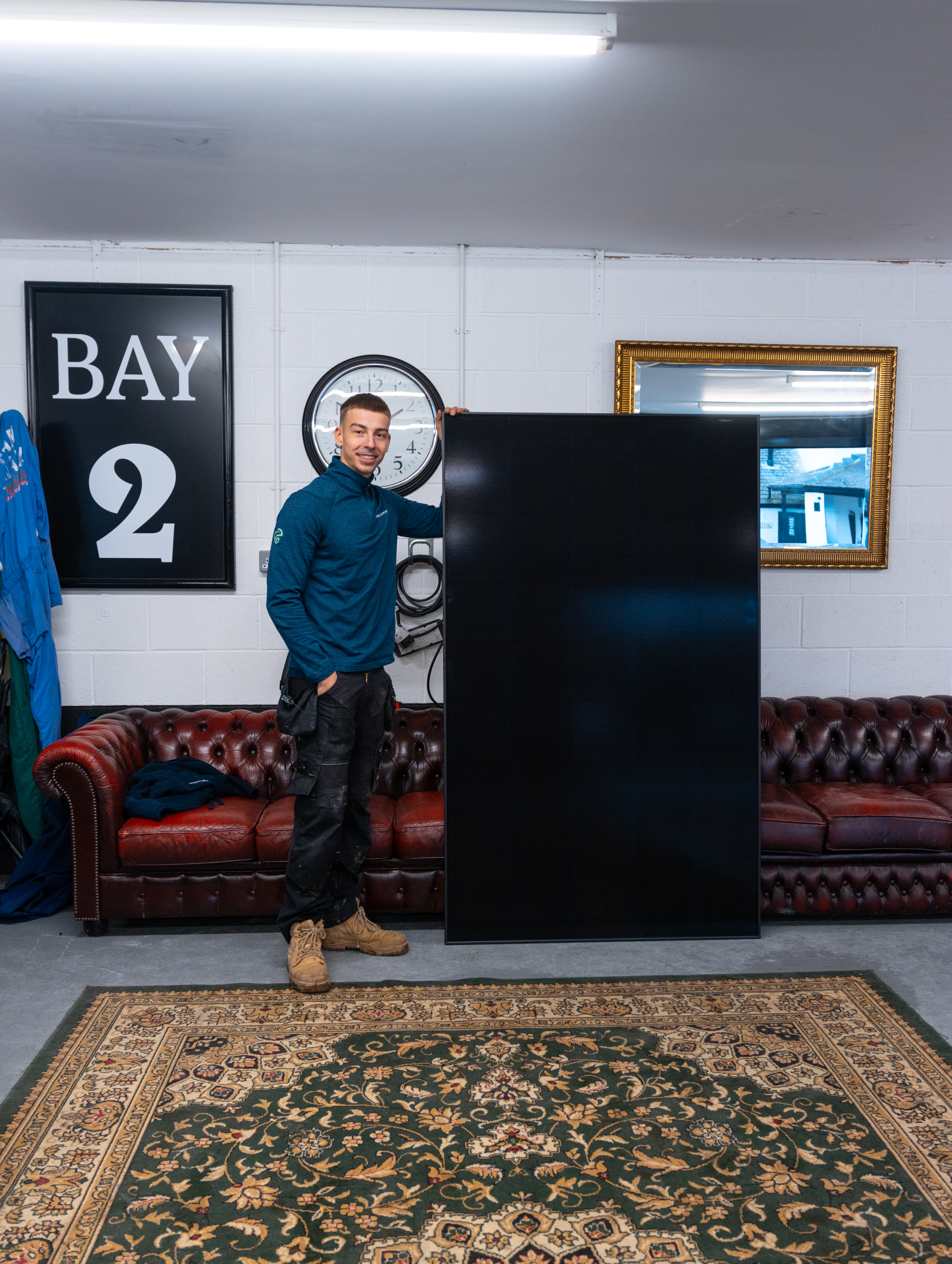
If your business runs a warehouse in Magna Park, a factory on the Leicester ring road, or an office in the city centre, your roof is one of the few assets on the balance sheet quietly doing nothing. In 2026, commercial rooftop solar in Leicestershire is a straightforward financial decision: predictable generation, capital allowances that cut your tax bill, and export income for anything you do not use on site. This guide, from Leicester-based (LE9) MCS-certified installer Energy Concerns Ltd, walks through real local yields, honest costs, the AIA and 50% first-year allowance rules, grid connection via G99, and how battery peak-shaving turns solar into a demand-management tool for East Midlands businesses.
Why Leicestershire rooftops are well-suited to commercial solar
Leicestershire sits in the East Midlands solar belt, where a well-sited array typically yields around 950–1,050 kWh per kWp per year. That figure holds across the county — from the logistics sheds at Magna Park near Lutterworth and the distribution units along the M1/M69 corridor, to industrial estates in Loughborough, Coalville, Hinckley, Melton Mowbray and the Leicester city fringe at Braunstone, Beaumont Leys and Thurmaston.
Commercial roofs are ideal because they combine three things: large uninterrupted surface area, high daytime electricity demand, and roughly a decade of continuous business occupancy to bank the savings. Warehouses and factories in particular consume most of their power in daylight hours — exactly when the panels are producing — so a high share of generation offsets grid import at full rate rather than being exported.
- Warehouses / distribution: vast flat or low-pitch roofs; huge kWp potential, often 100 kWp to several MW.
- Factories / manufacturing: heavy, steady daytime load — excellent self-consumption.
- Offices / retail: smaller arrays, but strong daytime demand from lighting, IT and HVAC.
Leicestershire's councils — Leicester City, Blaby, Harborough, Charnwood, Hinckley & Bosworth, North West Leicestershire, Melton and Oadby & Wigston — all recognise carbon reduction in their local plans, and most rooftop PV on existing commercial buildings is permitted development.
What commercial rooftop solar actually costs in 2026
Commercial solar is priced per kWp installed, and the rate falls as the system gets bigger. As a working guide for Leicestershire installs in 2026:
- Small (up to ~50 kWp): roughly £800–£1,100 per kWp installed.
- Medium (50–250 kWp): roughly £650–£900 per kWp.
- Large (250 kWp+): often £550–£800 per kWp, subject to roof, structure and connection.
A 100 kWp warehouse array therefore lands broadly in the £65,000–£90,000 range before tax relief, and can generate around 95,000–105,000 kWh a year. Every unit you self-consume displaces grid electricity at your business rate, which is where the bulk of the return comes from.
VAT note — this is important and often misunderstood: the well-publicised 0% VAT on solar and batteries (running until 31 March 2027, then reverting to 5%) applies to domestic installations only. Commercial installs are standard-rated for VAT. However, a VAT-registered business generally reclaims that VAT through its normal return, so it is a cash-flow item rather than a permanent cost. The real fiscal advantage for businesses comes from capital allowances, covered next.
Capital allowances: AIA (100%) and the 50% First-Year Allowance
This is the mechanism that makes commercial solar so tax-efficient — and it is genuinely different from the domestic incentives you may have read about. Solar PV is treated as plant and machinery, and specifically falls in the special rate pool. Two routes matter:
- Annual Investment Allowance (AIA): lets a business deduct 100% of qualifying plant and machinery spend, up to £1 million per year, against taxable profit in the year of purchase. Most Leicestershire commercial solar projects sit comfortably within this cap, so the whole installation can typically be written off in year one.
- 50% First-Year Allowance (FYA): because solar is a special-rate asset, it does not qualify for full expensing (the 100% first-year relief reserved for main-pool assets). Instead, for companies, the special-rate 50% FYA allows 50% of the cost in year one, with the remaining balance written down at the standard 6% special-rate writing-down allowance in following years.
In practice, most businesses use the AIA to claim 100% up front where the annual cap allows; the 50% FYA is the fallback for spend above the AIA limit. At the current 25% corporation tax rate, a £90,000 array fully relieved under AIA reduces your tax bill by around £22,500. Always confirm the treatment with your accountant, as it depends on your profit, entity type and total capital spend for the year — but the headline is that solar is one of the most tax-favoured investments a Leicestershire business can make.
Payback and return on investment for a Leicestershire business
Commercial solar payback is driven by three levers: how much you self-consume, your current electricity price, and the capital-allowance tax saving. For a typical Leicestershire warehouse or factory with high daytime load, cash payback commonly lands in the 4–7 year range — noticeably faster than domestic solar because businesses pay more for power and reclaim VAT, then recover a chunk of the capital through tax relief.
Worked illustration for a 100 kWp factory array in the county:
- Generation: ~100,000 kWh/year at East Midlands yields.
- Self-consumption at, say, 70%: ~70,000 kWh offset against grid import.
- At a business rate around 25–30p/kWh, that is roughly £17,500–£21,000 of avoided electricity cost a year.
- Exported surplus earns export income (see the SEG/PPA section below).
- Capital allowances recover a large share of the up-front cost in year one.
With panels warrantied for 25+ years and performance degrading only slowly, the system keeps saving long after payback. The single biggest driver of a good return is matching array size to your genuine daytime demand — oversizing for export alone is rarely the best commercial case, which is exactly why battery storage (below) is worth modelling.
Grid connection: G98, G99 and DNO approval in the East Midlands
Any commercial array has to connect to the grid under Energy Networks Association engineering recommendations, and in the East Midlands your Distribution Network Operator is National Grid Electricity Distribution (the former Western Power Distribution network covering Leicester and Leicestershire).
- G98: the notification route for small single-premises systems — broadly up to 3.68 kW per phase (about 16 A). This covers micro installs and is a simple connect-and-notify process.
- G99: the application-and-approval route for anything larger — which is virtually all commercial rooftop solar. You (or your installer) apply to the DNO before installation, and the network operator assesses whether the local grid can accept the generation and export.
For medium and large arrays this can take several weeks and, on constrained parts of the network, may come back with an export limit or a requirement for reinforcement. That is not a reason to hesitate — an export limitation device or a battery can keep the project viable even where full export is capped. As an MCS-certified installer, Energy Concerns Ltd handles the G99 application and commissioning paperwork as part of the project, so the connection is designed correctly from the start rather than becoming a costly surprise.
Battery storage and peak-shaving for demand management
Battery storage is where commercial solar becomes an active demand-management tool rather than just a generator. Battery cost in 2026 runs to around £400–£700 per usable kWh at commercial scale, and it earns its keep in several ways at once:
- Peak-shaving: the battery discharges during your highest-demand periods, flattening the peaks that drive up your capacity and demand charges. For factories with spiky loads, this can meaningfully cut the fixed elements of a commercial tariff.
- Time-shifting: store cheap or self-generated daytime solar and use it through late-afternoon and evening operations, raising your effective self-consumption.
- Export management: where G99 imposes an export limit, a battery soaks up surplus generation that would otherwise be curtailed.
- Resilience: depending on configuration, batteries can provide backup for critical loads during grid interruptions.
For a Leicestershire business on a half-hourly metered supply with significant peak charges, peak-shaving alone can materially shorten payback. Whether a battery pays back depends on your specific load profile — a business with steady daytime demand and low peaks may not need one, while a single-shift manufacturer with sharp afternoon peaks often benefits substantially. This is exactly the kind of modelling worth doing before committing.
Export income: SEG and Power Purchase Agreements
Electricity you generate but do not use on site earns you money. For smaller commercial systems, the Smart Export Guarantee (SEG) pays for every unit exported to the grid. SEG rates vary by supplier and typically sit in the 5–15p/kWh range — for example Octopus and British Gas both run SEG tariffs, with rates and terms differing between them, so it pays to shop the tariff. MCS certification is a requirement to qualify for SEG, which is one more reason to use an MCS-certified installer such as Energy Concerns Ltd.
For larger arrays — the multi-hundred-kWp warehouse rooftops around Magna Park or Bardon Hill, for instance — a commercial Power Purchase Agreement (PPA) can be a better route than SEG. Under a PPA, a third party may fund and own the system while you buy the power it generates at an agreed rate, or you sell bulk export under a negotiated commercial contract rather than a standard SEG tariff. The right structure depends on your capital position, your appetite to own the asset, and how much you self-consume.
As a general rule: maximise self-consumption first (that avoids buying power at full retail rate), then treat export income as the secondary return. Sizing the system to your load — not to the roof — is what produces the strongest commercial case.
Frequently Asked Questions
Ready to get it installed?
Get your free, no-pressure quotation
Tell us what you’re interested in — solar, battery storage, EV charging or air conditioning — and we’ll come back with an itemised quote. No salesman, no obligation.
No. The 0% VAT relief (in place until 31 March 2027, then reverting to 5%) applies to domestic installations only. Commercial solar is standard-rated for VAT. However, if your business is VAT-registered you can normally reclaim that VAT through your usual return, so it is a cash-flow item rather than a permanent extra cost. The main tax advantage for businesses comes from capital allowances instead.
Often, yes — via the Annual Investment Allowance (AIA), which allows a 100% deduction on qualifying plant and machinery up to £1 million per year, and most Leicestershire commercial solar projects fall within that cap. For spend above the AIA limit, solar is a special-rate asset, so it qualifies for the 50% First-Year Allowance (not full expensing), with the balance written down at 6% per year. Confirm the exact treatment with your accountant based on your profits and total capital spend.
Typically around 4–7 years for a business with high daytime demand, such as a warehouse or factory. Payback is faster than domestic solar because businesses pay more for electricity, reclaim VAT, and recover much of the up-front cost through capital allowances. The biggest driver of a good return is self-consumption — using the generation on site rather than exporting it — so matching array size to your daytime load matters more than filling the roof.
G99 is the grid-connection application and approval process for larger generation systems, which covers virtually all commercial rooftop solar. Your installer applies to the Distribution Network Operator (National Grid Electricity Distribution in the East Midlands) before installation, and the DNO assesses whether the local network can accept the generation. Smaller micro systems use the simpler G98 notification route. On constrained parts of the network you may receive an export limit, which a battery or export-limiting device can accommodate.
It depends on your load profile. Businesses with sharp demand peaks — for example single-shift manufacturers with heavy afternoon loads — often benefit strongly, because the battery discharges during peaks and cuts the demand-related charges on a commercial tariff. A business with steady, flat daytime demand may not need one. At around £400–£700 per usable kWh in 2026, a battery is worth modelling against your actual half-hourly consumption data before deciding.
MCS certification is required to qualify for the Smart Export Guarantee, which pays you for exported electricity, so an MCS-certified install protects your export income. It is also a strong quality benchmark. Energy Concerns Ltd is a Leicester-based (LE9) MCS-certified, RECC, NAPIT and TrustMark-registered installer covering Leicestershire and the wider East Midlands, and handles the full process including G99 grid application and commissioning.
Free, no obligation
Ready to go solar in the East Midlands?
Energy Concerns is MCS certified, RECC registered, and 5-star rated. We cover all of the East Midlands and Warwickshire — book a free survey and we'll give you honest, personalised advice.