

If your business runs compressors, refrigeration, ovens or CNC machinery anywhere between Loughborough and Lutterworth, the shape of your electricity use now matters almost as much as the amount. Half-hourly settlement, time-banded network charges and kVA capacity fees mean two Leicester firms using identical kilowatt-hours can pay very different bills. Commercial battery storage lets you "peak shave" — trimming the expensive spikes — while soaking up cheap overnight power or rooftop solar for use when rates bite hardest. This guide covers how peak shaving works, how to read your half-hourly data, realistic 2026 costs, capital allowances and payback for East Midlands businesses.
Why peak demand is the most expensive electricity your business buys
On a half-hourly metered supply, when you use electricity matters as much as how much. Around 40–60% of a typical business bill is now non-commodity cost — network and policy charges layered on top of the wholesale price. In the East Midlands licence area, operated by National Grid Electricity Distribution (formerly Western Power Distribution), distribution charges are time-banded: the red band, currently around 4pm–7pm on weekdays, costs several times the overnight green rate per unit. On top sit availability charges for your agreed kVA capacity — with penalty rates if a compressor start or oven cycle pushes you over it. The old game of "Triad chasing" is largely gone since the Targeted Charging Review moved residual network charges into fixed bands in 2022–23, but time-of-use price signals are now stronger than ever inside supply contracts themselves. For a food processor in South Wigston or a plastics firm on Braunstone Frith Industrial Estate, a thirty-minute spike at 5pm on a January weekday is the most expensive electricity of the year. Peak shaving exists to take exactly that spike off the grid.How peak shaving works
A commercial battery sits behind your meter and watches site load in real time. When demand climbs towards a set threshold — say 120kW on a site that normally idles at 60kW — the battery discharges to hold your grid draw below that line, then quietly recharges overnight on cheap-rate power or from rooftop solar during the day. Your metered peaks flatten, your half-hourly profile smooths, and the priciest units on your bill are replaced with the cheapest. Three savings mechanisms follow:- Lower consumption during red-band and peak-priced periods, where each unit costs the most.
- A smaller maximum demand, which can let you reduce your agreed kVA capacity and its daily availability charge, and avoid excess-capacity penalties.
- Headroom that defers paying National Grid Electricity Distribution for a connection upgrade when you add machinery, refrigeration or EV chargers.
Half-hourly data: how to get yours and what to look for
Larger supplies have had mandatory half-hourly (HH) metering for years, and market-wide half-hourly settlement — rolling out through 2026 and into 2027 — is extending settlement on actual half-hourly usage to nearly all business meters. That means your supplier already holds 17,520 readings a year on your site. Ask for twelve months of HH data as a CSV; suppliers provide it on request, and your appointed data collector can too. Then look for four things:- Peak kW — your highest half-hourly demand, and how far above your typical baseload it sits.
- Duration — do spikes last 30 minutes or three hours? This drives battery energy sizing.
- Timing — spikes inside the 4pm–7pm weekday red band are worth far more to shave.
- Seasonality — winter heating peaks versus summer chiller peaks need different strategies.
Sizing a commercial battery: kW versus kWh
Battery sizing has two independent numbers, and confusing them is the most common specification error. Power (kW) is how hard the battery can discharge — it sets the depth of the shave. Energy (kWh) is how long it can sustain that discharge — it must cover the duration of your spikes. Take a machining firm on Braunstone Frith Industrial Estate: baseload 55kW, with weekday peaks of 130kW lasting roughly 75 minutes when compressors, CNC spindles and the paint-shop heater overlap. Holding the site to 90kW needs 40kW of discharge power for 1.25 hours — about 50kWh delivered — plus headroom for depth-of-discharge limits and gradual degradation. A 50kW system with 70–80kWh usable capacity fits. Sensible sizing rules:- Do not chase the single worst spike of the year — the last few kW of shave deliver sharply diminishing returns.
- Size power from shave depth, energy from spike duration, then add 10–15% headroom.
- Oversizing wastes capital that never cycles; undersizing lets peaks punch through and erodes the whole business case.
Costs, VAT and capital allowances in 2026
Commercial battery systems in 2026 typically cost around £400–700 per usable kWh installed, with the rate per kWh falling as systems scale. That puts a 50kW/100kWh system at roughly £40,000–£70,000 and a 200kWh system at around £80,000–£140,000, depending on hardware, switchgear and installation complexity. Unlike domestic installations — which enjoy 0% VAT until 31 March 2027 — commercial projects carry 20% VAT, reclaimable in full if your business is VAT-registered. Capital allowances then do the heavy lifting: the Annual Investment Allowance gives 100% first-year relief on up to £1m of qualifying plant and machinery, comfortably covering most battery and solar projects. Where the AIA is already used up, note that solar panels are classed as special-rate assets attracting a 50% first-year allowance — they are not eligible for full expensing. In England, eligible onsite renewable generation and storage plant is also exempt from business rates until 2035. Be clear on one thing: there is no government grant for commercial battery storage, and you should be wary of anyone claiming otherwise. The economics stand or fall on the arithmetic — so have your accountant model the allowances before you commit.Payback: stacking the savings honestly
Here is the answer many installers won't give you: peak shaving alone rarely pays for a commercial battery quickly. Strong East Midlands business cases stack several value streams:- Time-of-use arbitrage — charging overnight and displacing daytime units; the spread on business time-of-use contracts is often 10–20p per kWh.
- Red-band avoidance — shifting 4pm–7pm weekday consumption onto stored energy.
- Capacity management — reducing agreed kVA, eliminating excess-capacity penalties, and deferring a costly supply-capacity upgrade; reinforcement for a growing unit in Coalville or Castle Donington can run to five figures and months of waiting.
- Solar self-consumption — usually the largest single stream, covered below.
- Resilience — specified with backup capability, a battery can hold refrigeration, servers or critical lines through an outage.
Pairing with rooftop solar: the East Midlands advantage
The East Midlands yields roughly 950–1,050kWh per installed kWp per year, and the region's commercial building stock is unusually solar-friendly. The steel portal-frame sheds at Magna Park in Lutterworth, Bardon Hill in Coalville and East Midlands Gateway at Castle Donington carry vast, shallow-pitched roofs well suited to PV; Leicester's older red-brick former hosiery mills around Frog Island and Belgrave need a structural survey first — and fragile or asbestos-cement roofs need specialist handling — but many still work well. A 200kWp array here generates roughly 190,000–210,000kWh a year, and a weekday business can self-consume most daytime output even before storage. The battery captures what the workday misses: exporting typically earns only around 5–15p per kWh through the Smart Export Guarantee (MCS-certified installations, up to 5MW) or a commercial export PPA, while every stored kWh displaces imported units costing two to five times that. Weekend and early-morning generation stops being given away cheaply. Rooftop commercial solar is usually permitted development in England, though listed buildings and conservation-area frontages need checking with your council — Leicester City, Blaby, Harborough, Charnwood or North West Leicestershire, depending on the site. Solar charges the battery free; the battery makes the solar work evenings and weekends.Local delivery: a Leicestershire installer who starts with your data
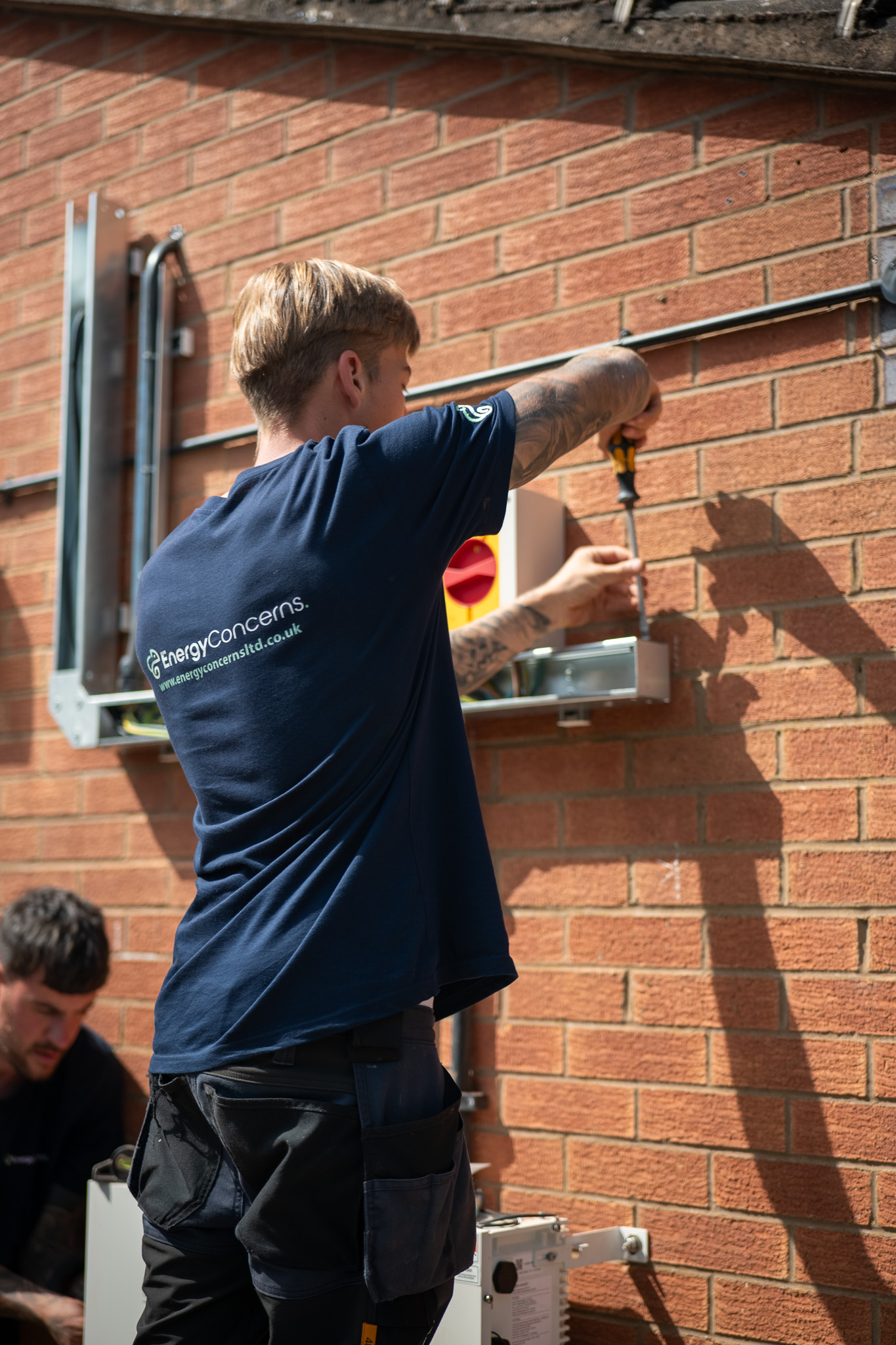
Energy Concerns Ltd is a family-run installer based in LE9, just south-west of Leicester, working within roughly 30 miles — covering Leicester itself, Loughborough, Hinckley, Market Harborough, Coalville, Melton Mowbray, Lutterworth and out towards Nottingham, Derby, Rugby and Coventry. The firm is MCS-certified, a RECC member, NAPIT-registered and TrustMark-approved, installing commercial-grade battery and hybrid systems from manufacturers including Sigenergy, Fox ESS and SolarEdge. A commercial project runs in a fixed order: twelve months of your half-hourly data first, then modelled shave thresholds and a solar yield assessment, a structural roof check where PV is involved, the G99 grid application to National Grid Electricity Distribution handled on your behalf, and finally installation with full monitoring handover so you can see the battery earning in real time. Because the modelling comes before the quote, you get an honest answer — including "a battery doesn't stack up for your profile" when that is what the data shows. If you run a unit on Meridian Business Park, a farm workshop near Broughton Astley or a factory floor in Wigston, send twelve months of bills and half-hourly data through the quote form and we will model it properly.Frequently Asked Questions
Ready to get it installed?
Get your free, no-pressure quotation
Tell us what you’re interested in — solar, battery storage, EV charging or air conditioning — and we’ll come back with an itemised quote. No salesman, no obligation.
Yes. Credible sizing starts from twelve months of half-hourly data — 17,520 readings showing your peak kW, spike duration, timing and seasonality. Your electricity supplier or appointed data collector will provide it on request, usually as a CSV. Any installer who quotes a battery size without seeing this data is guessing.
kW is power — how hard the battery can discharge, which sets how deep a peak you can shave. kWh is energy — how long it can sustain that discharge, which must cover your spike duration. A site with short, sharp peaks needs relatively more kW; long, sustained peaks need relatively more kWh.
Only if it is specified with backup or islanding capability from the outset — many grid-tied systems shut down in an outage by default. If refrigeration, servers or a production line are critical, say so at survey stage so the right hardware and wiring topology are designed in.
No — there is no government grant for commercial batteries, and schemes like ECO4 and the Warm Homes: Local Grant are for low-income households, not businesses. Commercial support comes through the tax system instead: 100% Annual Investment Allowance on up to £1m of plant, reclaimable VAT for VAT-registered firms, and business rates exemption on eligible onsite generation and storage plant in England until 2035.
Modern LFP (lithium iron phosphate) systems are typically warranted for ten years and rated for around 6,000 or more full cycles, with a design life of about fifteen years. A peak-shaving battery cycling roughly once per working day uses well under its cycle budget across the warranty period.
Usually not. Rooftop commercial solar is normally permitted development in England, and battery plant installed inside an existing building or yard rarely needs consent. The exceptions are listed buildings, conservation areas (especially panels on a principal elevation facing a highway) and larger external enclosures — check with your district council, such as Blaby, Harborough or North West Leicestershire, before ordering equipment.
Free, no obligation
Ready to go solar in the East Midlands?
Energy Concerns is MCS certified, RECC registered, and 5-star rated. We cover all of the East Midlands and Warwickshire — book a free survey and we'll give you honest, personalised advice.