

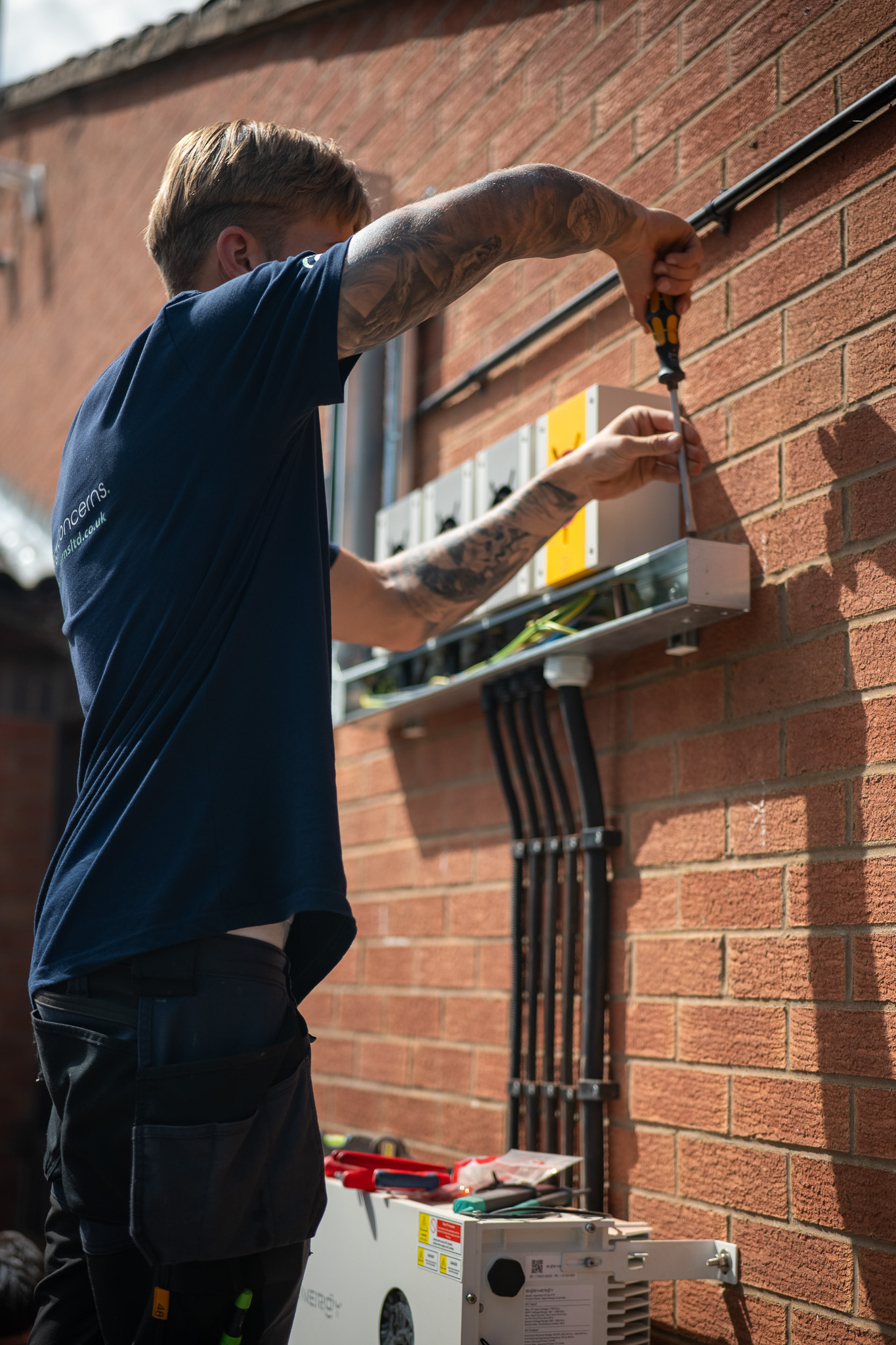
If you live in Leicester, Loughborough, Hinckley, Melton or anywhere across the East Midlands, you have probably wondered whether solar panels are actually worth the money in 2026 — or whether it is marketing hype. This is a straight-talking guide from Energy Concerns Ltd, an MCS-certified family installer based in Kirby Muxloe (LE9). We use real East Midlands sunlight figures, honest 2026 prices, current export rates and payback maths, plus the downsides most sales pitches skip. No inflated savings, no invented grants — just the numbers a Leicestershire household needs to decide with confidence. Read to the end for who solar suits, who it does not, and how to check your own roof.
The short answer for Leicestershire homes
For most owner-occupied homes across Leicester and the wider county, solar panels are worth it in 2026 — with realistic expectations. A well-sited, south-facing roof in the East Midlands typically pays for itself in around 6 to 9 years, then delivers roughly two more decades of near-free daytime electricity. The panels themselves usually carry a 25-year performance warranty, so the back half of that life is largely profit.
The honest caveats matter, though. Solar is worth it if you own your home, plan to stay a while, have a decent unshaded roof, and use (or can shift) some electricity during daylight hours. It is a weaker fit if you are moving soon, rent, have a heavily shaded or north-only roof, or are out all day with no battery and no way to use what you generate.
Three things make 2026 a genuinely good moment locally: 0% VAT on domestic solar and batteries (until 31 March 2027), export payments through the Smart Export Guarantee, and hardware prices that have settled after years of volatility. Below we put real numbers to all of it for the East Midlands specifically.
How much sun does the East Midlands actually get?
Leicestershire is not the sunny south coast, but it is far better for solar than most people assume. In the East Midlands, a well-installed system generates roughly 950 to 1,050 kWh per year for every 1 kWp installed. So a typical 4 kWp array — the common size for a three-bed semi in places like Wigston, Oadby, Syston or Coalville — produces around 3,800 to 4,200 kWh a year. That is a meaningful chunk of an average household's electricity use.
Orientation and pitch matter more than being 'up north'. South-facing roofs are best, but east-west split roofs still perform well and actually spread generation across morning and evening, which suits people who are out midday. The main enemies are shading (a tall chimney, a neighbour's conifer in a Clarendon Park terrace, or the church next to a village property in Kibworth or Market Bosworth) and steep north-only pitches.
- Cloud does not switch panels off — they still generate diffuse light on grey Leicestershire days, just less.
- Cooler UK temperatures actually help panel efficiency slightly versus very hot climates.
- A proper MCS installer models your roof's yield using its exact pitch, orientation and shading — not a national average.
What solar panels cost in Leicestershire in 2026
Here are honest, current East Midlands prices. Every figure below already includes 0% VAT, which applies to domestic solar and battery installs until 31 March 2027 (it reverts to 5% on 1 April 2027).
- 4 kWp system (no battery): roughly £6,000 to £8,000 fully installed — panels, inverter, mounting, wiring, scaffolding and DNO notification.
- Battery storage: budget around £400 to £700 per usable kWh. A popular 5 kWh battery therefore adds roughly £2,000 to £3,500; a 10 kWh unit proportionally more.
- Solar + battery together: commonly £9,000 to £13,000 depending on array and battery size.
Be wary of quotes far below these ranges — corners get cut on inverter quality, cabling or scaffolding safety. Equally, very high quotes are not automatically better. Always check the installer is MCS-certified (this is also a requirement to claim export payments) and ideally a member of RECC and TrustMark. As an MCS/RECC/NAPIT/TrustMark accredited installer, Energy Concerns provides an itemised quote so you can see exactly what you are paying for, with no VAT surprises.
Real savings, SEG export income and payback
A 4 kWp system in Leicestershire typically saves a household £700 to £1,100 a year once you combine bill savings and export income. The split depends heavily on how much you use during daylight and whether you have a battery.
Bill savings: every kWh you use directly instead of buying from the grid is worth whatever your unit rate is. Export income comes via the Smart Export Guarantee (SEG) — you must have an MCS-certified installation and register with an electricity supplier. SEG rates in 2026 vary a lot by supplier, roughly 5p to 15p per kWh — suppliers such as Octopus and British Gas run some of the better-known SEG tariffs. Rates can change, and some are fixed while others track, so always check the live figure with the supplier before you commit.
Two levers improve payback: (1) shift usage into daylight — run the dishwasher, washing machine or EV charging at midday; (2) add a battery to store cheap or self-generated power for evening use. Realistic payback for a Leicestershire home is 6 to 9 years for panels alone; adding a battery lengthens payback but raises total lifetime savings and resilience.
Should you add a battery? And EV charging
Batteries divide opinion, so here is the honest position. A battery does not generate any extra energy — it just lets you use more of what you make (or buy cheap overnight power on a time-of-use tariff and use it at peak). For a Leicestershire family out during the day, a battery can lift self-consumption from maybe 30-40% to 70%+, which is where the real value sits.
At £400-£700 per usable kWh, a battery adds cost and its own payback period, so it is worth it if: you are home in the evenings, you are on (or will switch to) a smart tariff, or you want backup during outages. It is less compelling if you are already using most of your generation live during the day.
On EV charging: pairing a solar-aware charger (like a Zappi) lets your car soak up surplus generation for free. Note the grant position has changed — the old OZEV domestic homeowner grant for houses is gone. The current EV chargepoint grant is aimed at flat owners and renters (with separate landlord versions), and is worth around £350 per socket. Standard homeowners of houses no longer qualify, so budget for the charger in full unless you live in a flat or rent.
Grants and funding for Leicestershire households
Let us be clear about what genuinely exists in 2026, because there is a lot of misinformation online. There is no FETF grant for domestic solar, and no universal 'free solar for everyone' scheme. What is real:
- 0% VAT on domestic solar and battery installs until 31 March 2027 — the biggest saving most households will get, applied automatically to your quote.
- ECO4 — funds energy measures (which can include solar) for lower-income households and those on qualifying benefits, often in EPC D-G rated homes.
- Warm Homes: Local Grant — delivered through your council (for Leicestershire residents that means checking with Leicester City Council, Blaby, Charnwood, Hinckley & Bosworth, Harborough, Melton, North West Leicestershire or Oadby & Wigston). It targets homes with an EPC of D-G plus a lower household income (commonly around £36,000 or less) or qualifying benefits, and can fund measures including solar and battery after a home assessment.
Grant availability, income thresholds and council rules change, so eligibility should always be confirmed directly with your local authority. If you do not qualify for grant funding, the 0% VAT plus SEG income still make a standard paid installation stack up for most owner-occupiers.
The honest downsides (that sales pitches skip)
Solar is a good investment for many Leicestershire homes, but it is not right for everyone, and you deserve the full picture:
- Upfront cost is real. £6,000+ is significant; the return comes over years, not months. If you might move within 3-4 years, you may not recoup it — though solar can add some resale appeal.
- Shading and roof aspect can kill the maths. A north-only roof or heavy shading from trees or neighbouring buildings (common in older Leicester terraces and village settings) sharply reduces yield.
- Roof condition matters. If your roof needs replacing soon, do that first — removing and refitting panels later adds cost.
- Winter output is low. December generation is a fraction of June's, so you will still draw grid power in the darker months.
- Inverters have a shorter life than panels (often 10-15 years) and may need replacing once during the system's life — factor that in.
- Quotes vary wildly. Always get MCS-certified quotes and avoid high-pressure doorstep sales.
If, after all that, your roof is decent, you own the home and plan to stay, solar in Leicestershire is very likely worth it.
Frequently Asked Questions
Ready to get it installed?
Get your free, no-pressure quotation
Tell us what you’re interested in — solar, battery storage, EV charging or air conditioning — and we’ll come back with an itemised quote. No salesman, no obligation.
Yes. Panels generate from daylight, not direct sun, so they still produce power on overcast East Midlands days — just less than in bright conditions. Annual yield here averages around 950-1,050 kWh per kWp, which already accounts for our typical mix of sunny and grey days across the year.
For a typical 4 kWp system on a well-sited Leicestershire roof, payback is usually 6 to 9 years, combining bill savings with Smart Export Guarantee income. Adding a battery lengthens payback but increases total lifetime savings. Panels commonly carry a 25-year performance warranty, so most of that life is profit.
Yes. The 0% VAT rate on domestic solar and battery installations applies until 31 March 2027, then reverts to 5% on 1 April 2027. It is applied automatically to a qualifying residential quote, so you should never see VAT added. Installing before the deadline locks in the saving.
Possibly. There is no universal free-solar scheme, but ECO4 and the council-delivered Warm Homes: Local Grant can fund solar for eligible lower-income households, typically in EPC D-G rated homes. Check directly with your local council (Leicester City, Blaby, Charnwood, Hinckley & Bosworth, Harborough, Melton, North West Leicestershire or Oadby & Wigston). Everyone else benefits from 0% VAT and SEG income.
Yes. To register for the Smart Export Guarantee and get paid for the power you export to the grid, your installation must be completed by an MCS-certified installer. Energy Concerns Ltd is MCS-certified (plus RECC, NAPIT and TrustMark), so your system will qualify for SEG registration.
It depends on your routine. A battery does not generate extra power; it stores what you make or cheap overnight power for later use. At roughly £400-£700 per usable kWh, it is worth it if you are out during the day, want evening self-sufficiency, or value backup. If you already use most of your generation live during daylight, panels alone may be the smarter spend.
Free, no obligation
Ready to go solar in the East Midlands?
Energy Concerns is MCS certified, RECC registered, and 5-star rated. We cover all of the East Midlands and Warwickshire — book a free survey and we'll give you honest, personalised advice.